5’4″ and 100 lbs: BMI, Is It Underweight, and What It Means
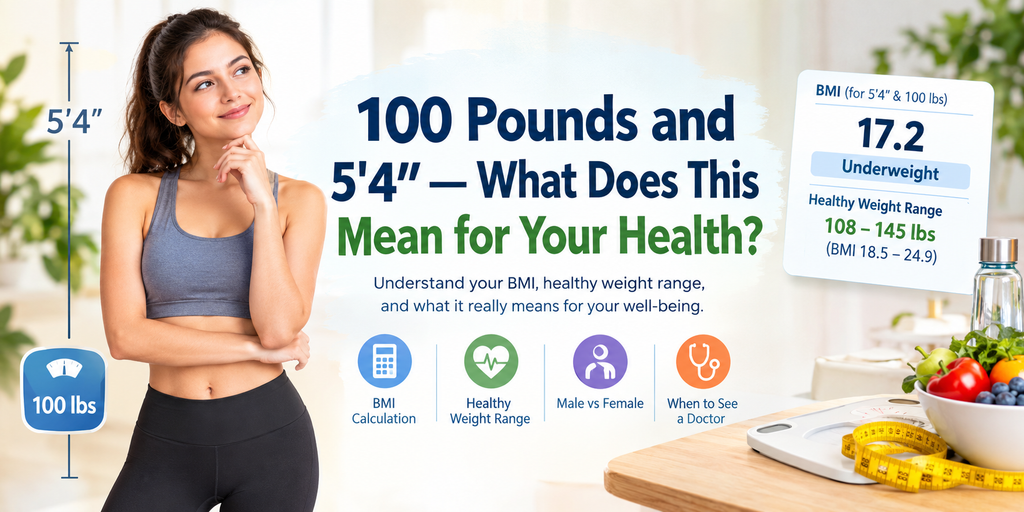
Last reviewed: November 2026. This page is for general information and is not medical advice.Quick answer: At 5’4″ (163 cm), 100 lbs (45 kg) gives a BMI of about 17.2. For an adult, that is in the underweight range (below 18.5). The healthy BMI range at this height is about 108 to 145 lbs (49 to 66 kg). BMI is only a screening tool, so the number alone cannot tell you whether there is a health problem.
Want to check your own numbers? Use our free BMI calculator.
5’4″ and 100 lbs BMI: How It’s Calculated
The formula for adults is:
BMI = (weight in pounds × 703) ÷ (height in inches)²
Five feet four inches is 64 inches. So: (100 × 703) ÷ (64 × 64) = 70,300 ÷ 4,096 = 17.16, usually rounded to 17.2.
The CDC uses these adult categories:
| Adult BMI category | BMI range | Approximate weight at 5’4″ |
|---|---|---|
| Underweight | Below 18.5 | Below about 108 lbs |
| Healthy weight | 18.5 to 24.9 | About 108 to 145 lbs |
| Overweight | 25.0 to 29.9 | About 146 to 174 lbs |
| Obesity | 30.0 or higher | About 175 lbs or more |
These ranges are a screening reference, not a personal target or an “ideal weight.”
BMI Chart for 5’4″ (100 to 180 lbs)
| Weight | BMI | Category |
|---|---|---|
| 100 lbs | 17.2 | Underweight |
| 105 lbs | 18.0 | Underweight |
| 110 lbs | 18.9 | Healthy |
| 112 lbs | 19.2 | Healthy |
| 120 lbs | 20.6 | Healthy |
| 130 lbs | 22.3 | Healthy |
| 140 lbs | 24.0 | Healthy |
| 145 lbs | 24.9 | Healthy (top of range) |
| 150 lbs | 25.7 | Overweight |
| 160 lbs | 27.5 | Overweight |
| 170 lbs | 29.2 | Overweight |
| 180 lbs | 30.9 | Obesity |
Is 145 lbs overweight at 5’4″?
No. At 5’4″, 145 lbs has a BMI of about 24.9, which is the top of the healthy range. BMI reaches the overweight category at about 146 lbs.
Is 112 lbs underweight at 5’4″?
No. At 5’4″, 112 lbs has a BMI of about 19.2, which is inside the healthy range. The underweight cutoff at this height is about 108 lbs.
5’4″ and 100 lbs: Male vs Female
For adults, the BMI formula and categories are the same for men and women. An adult male and an adult female who are both 5’4″ and 100 lbs have the same BMI of about 17.2.
What differs is body composition, such as the balance of muscle and body fat, and other biological factors that BMI cannot see. So the number is the same, but what it means for a particular person can be different.
Is 100 lbs at 5’4″ Different for a Teenager?
Yes. This matters a lot. People aged 2 to 19 are not judged with the adult BMI categories. For them, the CDC uses BMI-for-age percentiles that are specific to age and sex, because their bodies are still growing.
If you are a teenager, do not use the adult chart above to decide whether your weight is healthy. A doctor can look at your growth chart and your overall health.
Why BMI Alone Doesn’t Tell the Whole Story
BMI combines height and weight into one number. It does not measure muscle, bone, body fat, or nutrition. It also cannot tell you why someone weighs what they weigh.
Two adults can both be 5’4″ and 100 lbs and be in very different situations. One may have a naturally small frame and have been at a stable weight for years. Another may have lost weight over a few months without trying. The BMI is the same, but the health questions are not.
A better question than “Is 100 lbs too little?” is: “Is this weight right for my age, growth, health history, and how I feel?”
Is Being Underweight at 5’4″ a Health Concern?
Being in the underweight BMI range does not automatically mean you have a medical problem. Some people have small frames and stay at a low but stable weight for many years without trouble.
On the other hand, low weight can sometimes go along with not getting enough nutrients, or with an underlying condition. The NHS notes that a BMI below 18.5 can be linked to a risk of malnutrition.
The context matters most. A stable weight with no symptoms is a very different situation from recent, unexplained weight loss.
Signs that deserve attention
- Weight loss you did not intend
- Ongoing tiredness or weakness
- Getting sick often
- Loss of appetite or digestive problems
- Dizziness
- Changes in your menstrual cycle, if you have periods
None of these proves a specific condition. They are simply reasons to look beyond the BMI number.
When to Talk to a Doctor
Talk to a doctor if you have lost weight without knowing why, if you have trouble keeping your usual weight, or if you have any of the signs above. MedlinePlus advises getting medical advice if you lose more than 10 pounds, or 5% of your normal body weight, over 6 to 12 months without a clear reason.
A doctor can ask things a calculator cannot: when the change started, whether your appetite or digestion has changed, whether you have been ill, and how you feel day to day. They may suggest an exam, blood tests, or a visit with a dietitian.
If eating has become stressful or frightening, or is closely tied to worries about your body size, please talk to a trusted adult and a healthcare professional. Support is available, for example through a doctor or an eating disorder organization in your country, such as the National Alliance for Eating Disorders in the US. For teenagers in particular, personal guidance matters more than adult weight rules found online.
How to Support a Healthy Weight Safely
If a doctor decides you need support with nutrition or weight, the focus should be on health and nourishment, not on quick changes in body size.
- Find the cause first. A doctor or registered dietitian can check whether it is a nutrition issue, a medical condition, a change in appetite, or something else. Trying to fix unexplained weight changes without knowing the cause can delay proper care.
- Focus on nourishment. A varied diet with protein, whole grains or other carbohydrates, fruits and vegetables, healthy fats, and enough fluids is a common starting point. Your own needs may differ.
- Build strength for everyday life. Physical activity is good for strength, energy, and mobility. It should match your age, health, and nutrition, and it should not be used to control body size.
Performance numbers, social media challenges, and comparisons with other people cannot show whether someone is healthy. A better measure is whether you can do your daily activities comfortably and whether your health is being looked after.
Conclusion
For an adult, 100 lbs at 5’4″ gives a BMI of about 17.2, which is in the underweight category. The math is clear, but the health answer needs more context. BMI is a screening tool, not a diagnosis.
If this weight is stable for you and you have no symptoms, the BMI alone does not mean something is wrong. If your weight changed without explanation, or you feel tired, weak, or unwell, speaking to a healthcare professional is a better next step than relying on an online calculator.
FAQs
For an adult, yes. At 5’4″ and 100 pounds, the calculated BMI is approximately 17.2, which is below the adult BMI threshold of 18.5 used by the CDC to define the underweight category. However, BMI is a screening measure and does not by itself diagnose a health problem.
For someone under 20, adult BMI categories should not be used in the same way. Children and teenagers are assessed using BMI for age and sex specific percentiles because their bodies are still growing.
There is not one universally appropriate or medically meaningful “ideal weight” for every person who is 5’4″. For adults, the standard BMI framework places approximately 108 to 145 pounds within the 18.5 to 24.9 BMI range at that height, but those figures are a screening reference rather than a personal target.
Health professionals can consider additional information such as medical history, body composition, symptoms, nutrition, and changes in weight when assessing an individual.
For adults, a BMI from 18.5 to 24.9 is classified by the CDC as the healthy weight category. At 5’4″, that corresponds mathematically to approximately 108 to 145 pounds. BMI should still be interpreted alongside other health information rather than used as the sole measure of wellbeing.
For children and teenagers, the interpretation is different because BMI is evaluated using age and sex specific percentiles.
Yes. This is one of the most important distinctions when searching 100 pounds 5 4. A 15-year-old should not use the adult BMI category of under 18.5 to decide whether their weight is healthy. The CDC uses BMI for age and sex specific percentiles for people ages 2 through 19 because growth and development affect how height and weight should be interpreted.
A healthcare professional can interpret a teenager’s growth pattern using the appropriate growth chart and the person’s broader health history.
BMI can sometimes give an incomplete picture because it does not distinguish among muscle, fat, bone, and other components of body weight. That is one reason the CDC recommends considering BMI together with other information rather than treating it as a standalone diagnosis.
For a person concerned about their BMI, a healthcare professional can consider body composition, health history, physical findings, nutrition, and other relevant factors to provide a more complete assessment.