Best Budget Planner for 2026
Start With a Free Online Budget Planner
If you are searching for the best planner with budget features, you probably do not need another complicated financial system. You need something that helps you answer a simple question: where is my money going, and how much can I safely spend? A good online budget planner gives you a practical way to enter your income, organize expenses, see what remains, and plan for savings without turning budgeting into a full time project. If you are just getting started, simplicity matters even more because a budget that takes too long to maintain is easy to abandon. The goal is not to create a perfect spreadsheet that looks impressive. The goal is to create a useful spending plan that reflects your real life. A browser based planner can also make sense when you want something quick rather than a separate app, subscription, or physical notebook. For people who prefer writing things down, a budget planner notebook, budget binder, or free budget planner printable can still be useful. The right choice depends on how you actually manage money, not how complicated the planner looks.
Build your budget directly in the planner above. Enter your income, add your expenses, check the remaining amount, and use the result as your spending plan.
Why Use an Online Budget Planner Instead of an App or Notebook
An online budget planner is useful because it removes much of the friction between deciding to budget and actually creating a budget. You do not need to find a notebook, create a spreadsheet from scratch, or spend time learning a complicated financial application. You can open the planner in a browser, enter the numbers you already know, and organize your month around them. That makes the process especially appealing when your main goal is simply to understand your income and expenses. A notebook has its own advantages, particularly for people who enjoy handwriting and physical organization, but you have to do the calculations yourself. An app can provide much deeper features, but those features can be unnecessary if all you want is a straightforward spending plan. For example, Monarch currently lists paid plans beginning at $99.99 annually for its Core plan, with additional features available in a higher tier. That does not make a paid app bad; it simply means there is a difference between a full personal finance platform and a simple budget planning tool.
Less Setup and No Manual Math
The biggest advantage of a simple planner is often the reduction in effort. Think of budgeting like planning a road trip. You need to know where you are starting, where you want to go, and how much fuel you have available. You do not necessarily need a giant navigation system with dozens of advanced features. For many people, income, essential bills, everyday spending, debt payments, and savings are enough to create a useful starting picture. An online planner can make that process easier because the calculations can happen as you enter the numbers. You can also revise your figures when something changes rather than crossing out amounts in a notebook or rebuilding a spreadsheet. That flexibility is particularly helpful when income varies, bills change, or you want to compare different spending scenarios. The Consumer Financial Protection Bureau recommends looking carefully at actual spending, including irregular expenses, miscellaneous costs, and regular savings contributions when creating a realistic monthly budget. A useful planner should therefore help you organize the numbers that actually matter instead of encouraging you to create unnecessary categories.
How Our Budget Planner Works
A good budget planner should make the basic process easy enough that you can understand it without reading a financial textbook first. Start by entering your expected income for the period you want to plan. If you receive one regular paycheck, that may be straightforward, while people with multiple income sources can add each source separately and work with the combined amount. Next, enter your expected expenses. Housing, utilities, transportation, groceries, insurance, subscriptions, debt payments, entertainment, and other everyday costs can be organized into categories that make sense for your situation. Once those figures are entered, the planner can show the relationship between money coming in and money going out. That gives you a much clearer picture than looking at individual transactions without considering the whole month. The important thing is to use realistic numbers rather than optimistic guesses. If groceries normally cost $400 but you enter $200 because you hope to spend less, your budget may look great on screen while failing in real life.
Build a Monthly Budget in Minutes
The same approach can work for a monthly budget planner template, weekly planning, or another period that matches your income schedule. A monthly plan is popular because many major household bills arrive monthly, but that does not mean everyone should think about money only once a month. If you are paid weekly or every two weeks, you can use the monthly plan as your larger framework and then review it around each payday. Start with income, subtract planned expenses, and then look at the amount left for savings, flexible spending, and unexpected costs. If the result is negative, that is useful information rather than a failure. It tells you that something needs attention before the month gets away from you. You might reduce a flexible category, postpone a purchase, increase income, or reconsider a recurring expense. If there is money left over, give that money a purpose instead of allowing it to disappear through small purchases. A planner becomes much more valuable when it helps you make decisions before spending happens.
Who This Budget Planner Is Best For
The best budget planner for beginners is usually not the one with the largest number of pages, graphs, or features. It is the one that makes the first step feel manageable. Someone who has never created a budget can easily become overwhelmed by terms such as cash flow, sinking funds, asset allocation, debt snowball, net worth, and account synchronization. Those concepts can be useful, but they are not necessary for creating your first spending plan. A beginner can start with four questions: How much money comes in? What bills must be paid? What do I normally spend? How much do I want to save? Once those answers are visible, you can make the system more detailed as your confidence grows. The same approach can work for students learning money management, people starting their first job, households trying to reduce unnecessary spending, or anyone who simply wants a clearer view of monthly finances. A budget is not a test you pass or fail. It is a planning tool that should become more accurate as you learn more about your own spending habits.
What to Include in a Good Budget
A useful budget should capture the major areas that affect your financial decisions without becoming so detailed that maintaining it feels impossible. Your starting point is income because every spending decision needs to fit within the money available to you. After that, separate expenses into categories that help you understand where your money is going. Housing and utilities are usually easier to predict, while groceries, transportation, entertainment, and miscellaneous purchases may change from month to month. Savings should also have a place in the plan instead of being treated as whatever happens to remain at the end. The CFPB specifically recommends including regular savings contributions and reviewing several months of spending so less frequent costs are not overlooked. That is an important practical point because annual insurance payments, school expenses, gifts, travel, repairs, and other occasional costs can make a budget look inaccurate if they are ignored.
Income, Fixed Expenses, and Variable Expenses
Separating fixed and variable expenses can make your budget much easier to understand. Fixed expenses are costs that generally stay similar from one period to another, such as rent or a recurring payment. Variable expenses can move up or down depending on your choices or circumstances. Groceries, entertainment, fuel, dining out, and shopping are common examples. There may also be irregular expenses that do not happen every month but still need to be planned for. When you place these expenses into a planner, you can see which parts of your budget have flexibility and which do not. That distinction matters when you need to reduce spending because cutting a flexible category is usually more realistic than pretending a fixed bill does not exist. You can also create a miscellaneous category so unexpected but legitimate costs have somewhere to go. The CFPB specifically recommends including miscellaneous expenses when building a realistic budget. A strong budget therefore does not assume every month will behave perfectly. It leaves room for real life.
Prefer Paper? Budget Planner Notebooks and Binders
Not everyone wants to budget online. A budget planner notebook or budget binder can be a good choice if writing numbers down helps you pay attention to them. There is something different about physically recording a purchase, turning a page, and seeing your progress develop over time. Paper can also be useful for people who do not want their budgeting process connected to accounts or financial software. Several physical planners are available at different price points. For example, Clever Fox currently lists budget planners from around $19.99, with some larger and premium versions costing more. Erin Condren currently lists its Hardbound Budget Notebook at $16.50 before any displayed discount, with 106 pages and sections designed for weekly budget goals, money habits, bills, and financial tracking. GoGirl also lists budget planners in several sizes, including a compact version at $16.99 and a medium version at $19.99 at the time checked. Prices can change, so these figures are best treated as current examples rather than permanent prices.
| Format | Current example | Best suited to |
|---|---|---|
| Clever Fox budget planner | Around $19.99 and up | People who prefer structured paper planning |
| Erin Condren budget notebook | $16.50 listed price | People who prefer a compact notebook |
| GoGirl budget planner | Around $16.99 and up | People who want a portable paper planner |
| Online budget planner | Free option | People who want quick browser based planning |
The important question is not which notebook has the prettiest cover. Ask yourself whether you will actually open it and use it. A $20 planner sitting on a shelf has less value than a simple free planner that you use every week. If handwriting helps you stay engaged, paper may be exactly what you need. If you prefer speed and easy calculations, an online planner may fit your routine better. There is no rule saying you must choose one method forever. Some people use an online planner for calculations and keep a notebook for goals or spending notes. Others print their monthly plan and keep it in a binder. The useful system is the one that makes your financial information easier to see and act on.
Want a Printable Version? Use a Free Budget Planner Template
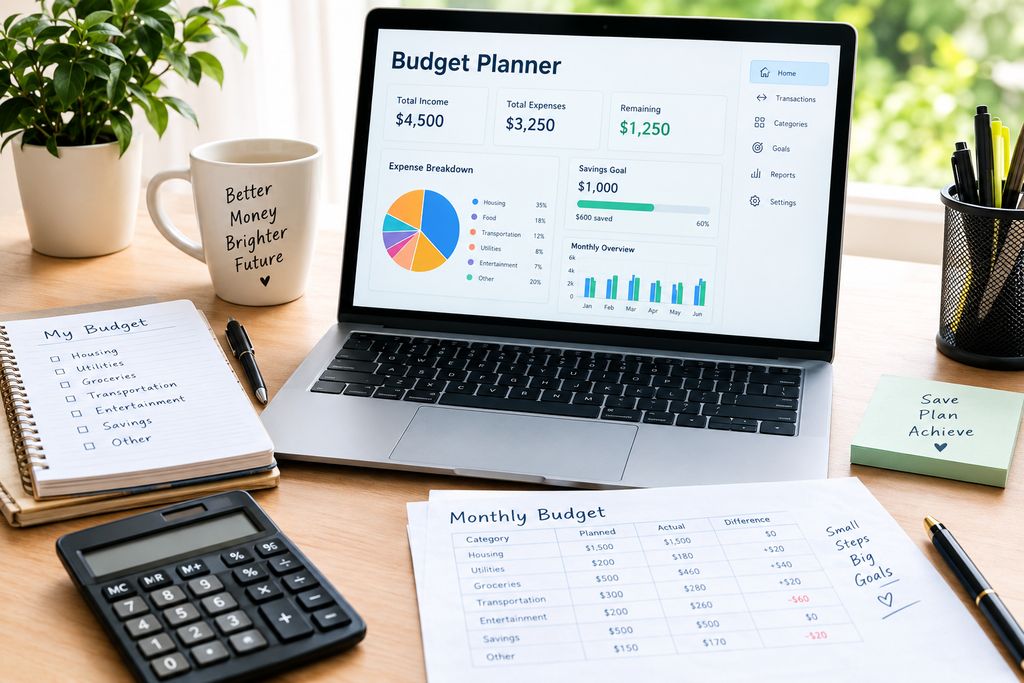
A free budget planner printable can be the middle ground between a digital planner and a notebook. You get a structured page without buying a physical financial planner, and you can keep the completed pages in a folder or binder. This can be particularly useful if you like seeing your entire month on paper but do not want to calculate every figure manually. A printable template can include sections for income, housing, utilities, food, transportation, debt, savings, personal spending, and miscellaneous expenses. You can also print a fresh copy each month instead of trying to reuse the same page. The biggest advantage is flexibility. You can write by hand, highlight important categories, add notes, and keep older months for comparison. The downside is that printed pages do not automatically update when numbers change, so you still need to make corrections manually. That is why an online planner can be a convenient starting point: create the plan digitally first, then print or save the information if you prefer a physical record. The two methods do not have to compete.
Online Budget Planner vs Notebook vs App
Choosing between an online budget planner, notebook, and budgeting app becomes easier when you focus on what you actually need. If you want quick calculations without installing anything, an online planner can be enough. If you enjoy handwriting and want a physical record, a notebook or binder may be more satisfying. If you want account connections, automated transaction tracking, reports, alerts, and more advanced financial management, a dedicated budgeting app may offer capabilities that a simple planner does not. For example, Monarch currently describes features such as account connections, budgeting, reports, savings and debt goals, and additional planning tools within its paid service. That level of functionality is designed for broader personal finance management rather than simply filling out a monthly budget.
| Format | Cost | Setup | Best for |
|---|---|---|---|
| Online budget planner | Free option | Very quick | Simple budgeting and calculations |
| Printable planner | Free or low cost | Quick | People who prefer paper |
| Budget notebook | Usually one time purchase | Quick | Handwritten tracking |
| Budget binder | Varies | Moderate | People who want reusable sections |
| Budgeting app | Free or paid depending on service | Moderate | Automated and advanced tracking |
There is no reason to pay for features you will never use. If your main search is best planner with budget, start with the simplest system that can solve your actual problem. You can always move to a more advanced system later if your needs change. Starting simple also reduces the chance that budgeting becomes another complicated task you avoid. The goal is visibility and control, not collecting financial tools.
How to Make a Monthly Budget That Actually Works
A monthly budget planner becomes useful when the numbers reflect your real behavior. Begin with take home income rather than an amount you hope to receive. Then list your regular bills and examine your spending from previous weeks or months. If you have access to your transaction history, review it carefully rather than relying entirely on memory. Small purchases are easy to overlook, but repeated small purchases can add up. At the same time, do not make the opposite mistake of creating an unrealistically strict budget that leaves no room for normal life. A budget should help you make better decisions, not make every purchase feel like a failure. Once you have realistic categories, decide what you want your remaining money to accomplish. That might mean building savings, paying down debt, preparing for an irregular bill, or keeping a reasonable amount available for flexible spending. The CFPB recommends comparing your completed budget with actual take home income and checking bank statements to make sure the plan is realistic. That simple review can make a bigger difference than constantly changing budgeting methods.
Tips for Sticking to Your Budget
Creating the budget is only the first half of the process. The harder part is using it consistently after the excitement of making a new plan disappears. One practical approach is to check your budget at least once a week rather than waiting until the end of the month. A weekly check gives you time to notice if one category is moving faster than expected. You can then adjust before the problem becomes difficult to fix. Another useful habit is to create a small buffer for expenses you cannot predict perfectly. If your plan assumes every month will be identical, one unexpected expense can make the entire system feel broken. You should also review your budget around payday because that is when many people naturally make spending decisions. Keep your savings goal visible so it has a purpose rather than feeling like money that simply disappeared. Finally, treat your budget as a living document. If a category consistently turns out to be unrealistic, change the number and learn from the pattern instead of repeatedly blaming yourself for missing it.
How to Use a Budget Planner for Savings Goals
A budget planner should not only tell you what you can spend. It should also help you decide what you want your money to accomplish. A savings goal can be something immediate, such as preparing for an upcoming expense, or something longer term, such as building an emergency reserve. The Consumer Financial Protection Bureau describes an emergency fund as money set aside for unplanned expenses and explains that even smaller savings can help people handle unexpected costs without immediately turning to other sources of money. Your planner can make this goal more concrete by recording the target amount and the amount you intend to contribute regularly. For example, instead of writing “save more,” you can give the goal a name and a specific target. Then your monthly budget can show whether that contribution fits comfortably with your other priorities. If it does not, you have useful information. You can adjust the target, timeline, or spending plan. The point is not to make a dramatic promise that lasts for two weeks. A realistic savings goal should be something your regular budget can support.
How Beginners Can Start Budgeting
If you are completely new to budgeting, do not try to build the perfect financial system on your first attempt. Start by writing down every reliable source of income you expect during your planning period. Then list the bills and expenses that you already know about. After that, look at your recent spending and identify categories that may have been missing from your first list. This is where a simple budget planner for beginners becomes useful because you can see the entire picture without needing advanced financial knowledge. Once the basic numbers are entered, look at the amount remaining. If the number is positive, decide how much should go toward savings, planned future expenses, and flexible spending. If it is negative, do not panic. The purpose of the first budget is partly to discover where the problem exists. You may find an overlooked subscription, unusually high discretionary spending, or an expense that needs to be planned differently. Your first budget is a starting measurement, not a permanent judgment about your financial situation.
Common Budgeting Mistakes to Avoid
One of the most common mistakes is creating a budget from guesses instead of actual spending. People often underestimate groceries, transportation, entertainment, and irregular expenses because those costs do not feel significant individually. Another mistake is forgetting annual or occasional bills. A yearly expense can seem invisible during eleven months of the year and suddenly become a major problem during the month it arrives. Another common issue is making the budget so restrictive that normal spending becomes impossible. If the plan does not reflect your actual life, you may stop using it altogether. It is also easy to create too many categories. Twenty or thirty tiny categories may look detailed, but if you cannot maintain them, the detail becomes noise. Start with categories that help you make decisions. You can always divide a category later if the additional detail provides value. Finally, avoid changing the entire budgeting system every time you have a difficult month. Review what happened, identify the cause, and make a targeted adjustment. Consistency usually comes from improving a workable system rather than constantly searching for a new one.
Is an Online Budget Planner Safe to Use
Safety depends on how a particular planner handles information and what information you choose to enter. A basic budget planner that asks you to enter income and expense amounts manually can involve less information than a financial application that connects directly to bank accounts. That does not mean every online planner is automatically safe, so you should understand what information a particular service requests and how it handles data. For a simple budgeting exercise, there is generally no reason to enter sensitive information such as passwords, full account credentials, or unnecessary identifying details into a generic calculator. Keep the information you enter limited to what is actually required for the calculation. If a service offers account connections, review its privacy and security information before connecting anything. A simple manual planner can also be useful for people who want to avoid account synchronization altogether. The basic principle is straightforward: share only the information necessary for the task. Budgeting should give you a clearer view of your money without requiring you to expose information that the planner does not need.
FAQs About Budget Planners
Budget planners often seem simple, but people have different expectations when they search for one. Some users want an online budget planner that works immediately. Others are specifically looking for a free budget planner printable, a budget planner notebook, or a more advanced budgeting application. The questions below address the most common search intents without assuming that one format works for everyone.
What Is the Best Free Online Budget Planner
For someone who wants straightforward budgeting without purchasing a physical notebook or paying for a full financial management subscription, a free online planner can be a practical starting point. The most useful option is one that lets you enter income and expenses easily, calculates the important totals, and makes the result understandable. Beginners generally benefit from simplicity because they can focus on learning their spending patterns rather than learning complicated software. Before choosing any online tool, check what information it requires and whether it fits the way you prefer to budget. If you want automatic bank connections, reports, and extensive financial tracking, you may need a more advanced service. If you simply want to organize monthly income and expenses, a browser based planner may be enough.
Do I Need an App to Make a Budget
No. You can create a budget using an online planner, spreadsheet, printable worksheet, notebook, or budget binder. An app becomes useful when you specifically want features such as automatic transaction imports, account synchronization, recurring transaction tracking, alerts, or more detailed financial reports. Those features can save time, but they are not required to understand your income and expenses. If you are starting from zero, a simple online budget planner may actually make the learning process easier because there are fewer things competing for your attention. You can always move to a more advanced method later. The important part is creating a plan that you will actually review and use.
What Is the Best Budget Planner for Beginners
The best choice for a beginner is generally a planner with a clear structure and only the features you need. You should be able to enter income, list expenses, see the amount remaining, and plan savings without needing specialized financial knowledge. A monthly budget planner template can work well if you prefer paper, while an online planner can be faster if you want automatic calculations. A notebook may be better if handwriting helps you stay engaged. There is no universal format that is right for everyone. Start with the simplest option you are likely to use consistently and make it more detailed only when you understand what additional information would help.
Can I Print a Budget After Creating It
Yes, if the tool you use provides a print or export option, you can keep a physical copy of your completed budget. Printing can be useful if you prefer a paper record or want to place your monthly plan inside a budget binder. A printed plan can also serve as a quick reference during the month. If your planner does not offer a built in print function, you can often use the browser’s standard print function, depending on how the page is designed. Keeping previous monthly budgets can help you compare planned spending with actual spending over time. Just remember that a printed budget is a snapshot. If your income or expenses change, update the plan rather than continuing to rely on outdated figures.
What Is the Difference Between a Budget Planner and a Budgeting App
A budget planner generally focuses on creating and organizing a spending plan. A budgeting app can provide a broader set of financial management features, particularly when it connects to financial accounts and automatically tracks transactions. For example, Monarch currently advertises budgeting, spending reports, savings and debt goals, and connections to thousands of financial institutions as part of its paid service. That can be useful for people who want a complete financial dashboard. A simple planner is better suited to someone who mainly wants to enter numbers, understand their available money, and create a spending plan. The right choice depends on how much automation and financial tracking you actually need.
Start Budgeting for Free
You do not need an elaborate financial system to take the first step toward better budgeting. Start with your income, add your regular expenses, include savings and irregular costs, and look at what remains. If you have been searching for the best planner with budget features, begin with the simplest option that lets you understand your numbers clearly. Use an online budget planner when you want speed and convenience, choose a budget planner notebook or budget binder when you prefer handwriting, or use a free budget planner printable when you want something physical without buying a dedicated planner. The important thing is not the format. It is having a realistic plan that you actually revisit. Build your budget, check it regularly, learn from your real spending, and adjust it as your circumstances change. A useful budget should feel less like a restriction and more like a map that shows you where your money can go.
Conclusion
The best planner with budget features is not necessarily the one with the most complicated dashboard or the biggest number of pages. For many people, the better starting point is a simple system that makes income, expenses, savings, and remaining money easy to understand. A free online budget planner can provide that starting point without requiring a physical notebook or a paid financial application. People who prefer paper can choose a budget planner notebook, budget binder, or free budget planner printable, while users who want automation may prefer a dedicated budgeting app. The key is matching the tool to your actual habits. Start with realistic numbers, include expenses that do not happen every month, give savings a clear place in the plan, and review your spending regularly. When your budget reflects real life, it becomes much easier to maintain. The best budget planner is ultimately the one you will continue using because it makes your money easier to understand and your next financial decision easier to make.