Convert cm to ml Calculator: How to Convert Centimeters to Milliliters
If you searched for a convert cm to ml calculator, you may be trying to turn a measurement in centimeters into a volume in milliliters. The important thing to understand first is that cm and ml measure different things. A centimeter measures length, while a milliliter measures volume. You cannot convert a single length measurement such as 5 cm directly into milliliters unless you also know the shape and the other dimensions needed to calculate its volume.
The situation becomes much easier when you are working with cubic centimeters (cm³). A cubic centimeter is a unit of volume, and 1 cm³ is exactly equal to 1 ml. This means that once you calculate the volume of an object in cubic centimeters, you can use the same numerical value in milliliters. For example, 250 cm³ equals 250 ml, while a cube measuring 5 cm × 5 cm × 5 cm has a volume of 125 cm³, which is also 125 ml.
This guide explains how the conversion works, which formulas to use for common shapes, how cm³, cc, and ml relate to one another, and how to avoid the mistakes that commonly cause incorrect answers.
Quick Answer: Is 1 cm³ Equal to 1 ml?
Yes. 1 cm³ = 1 ml exactly. If you already have a measurement expressed in cubic centimeters, the conversion requires no multiplication or division. A volume of 10 cm³ is 10 ml, 100 cm³ is 100 ml, and 1,000 cm³ is 1,000 ml, which is equal to 1 liter.
The confusion usually happens because people write cm when they actually mean cm³. The difference is important. A measurement of 1 cm describes a one-dimensional length, while 1 cm³ describes the volume of a cube that is 1 cm long, 1 cm wide, and 1 cm high. In other words, the small “³” changes the unit from length to volume.
If you are using a convert cm to ml calculator, first determine whether your input represents a simple length or a volume. If it is already cubic centimeters, simply use the same number as milliliters. If you only have dimensions in centimeters, multiply the appropriate dimensions according to the shape.
For a rectangular box, the calculation is straightforward:
Volume = length × width × height
So, a box measuring 10 cm × 5 cm × 2 cm has a volume of 100 cm³. Because 1 cm³ equals 1 ml, its volume is 100 ml.
Can You Convert cm to ml Directly?
Not from a single centimeter measurement. Centimeters are units of length, while milliliters are units of volume, so there is no universal conversion such as “1 cm = X ml.” To find a volume, you need enough information about the object’s three-dimensional shape. Think of it like asking how much water a container holds when you only know its height. The height tells you something about the container, but it does not tell you its complete capacity.
For example, imagine two containers that are both 20 cm tall. One might be very narrow, while the other could be wide. Their heights are identical, but their capacities can be completely different. That is why a convert cm to ml calculator needs additional dimensions or a shape before it can determine the volume.
If you know the length, width, and height of a rectangular object, multiply those three measurements. If you have the radius and height of a cylinder, use the cylinder formula. For a sphere, you need its radius. Once the result is expressed in cubic centimeters, converting it to milliliters is simple because the numerical values are identical.
This distinction is especially useful when working with containers, packaging, cooking measurements, laboratory calculations, engineering dimensions, or educational problems. The key question is not simply “How many ml is one cm?” but rather “What volume does this three-dimensional measurement represent?”
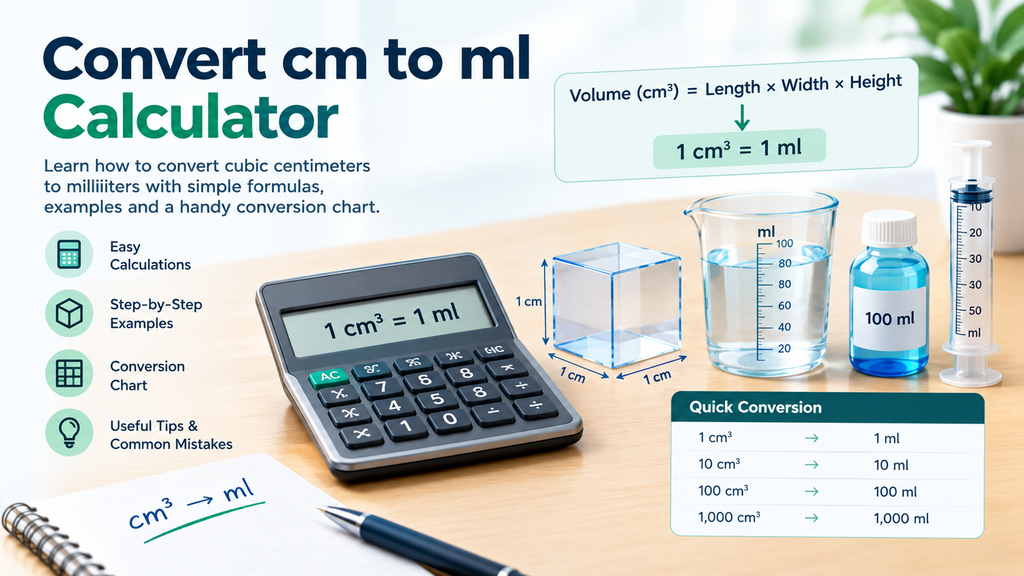
cm to ml Formulas
The correct formula depends on whether you already have a volume or are starting with dimensions. If the volume is already given in cm³, the calculation is immediate: milliliters = cubic centimeters. If you are starting with dimensions measured in centimeters, calculate the shape’s volume first.
For a rectangular box, use mL = length × width × height when all three dimensions are measured in centimeters. For a cube, where all sides have the same measurement, use mL = side × side × side, or simply side³. For a cylinder, use mL = π × radius² × height, and for a sphere use mL = 4/3 × π × radius³.
These formulas work because the resulting volume is measured in cubic centimeters. Once you have that volume, the numerical conversion to milliliters is one-to-one. This is the most important idea behind a convert cm to ml calculator metric.
Cubic Centimeters to Milliliters
The simplest formula is:
mL = cm³
Examples include:
1 cm³ = 1 ml
25 cm³ = 25 ml
100 cm³ = 100 ml
500 cm³ = 500 ml
1,000 cm³ = 1,000 ml = 1 liter
There is no additional conversion factor between cubic centimeters and milliliters.
Box or Rectangular Container
For a rectangular container:
Volume = length × width × height
If the dimensions are 12 cm × 10 cm × 5 cm:
12 × 10 × 5 = 600 cm³
Therefore:
600 cm³ = 600 ml
This is one of the most common calculations for containers and packaging.
Cylinder
For a cylinder:
Volume = π × r² × h
Here, r is the radius and h is the height. If the radius is 3 cm and the height is 10 cm:
π × 3² × 10 = approximately 282.7 cm³
Therefore:
282.7 cm³ ≈ 282.7 ml
Sphere
For a sphere:
Volume = 4/3 × π × r³
If the radius is 3 cm:
4/3 × π × 3³ = approximately 113.1 cm³
Therefore:
113.1 cm³ ≈ 113.1 ml
The important point is that the shape determines the formula. There is no single formula that can convert an ordinary centimeter measurement to milliliters without additional information.
Step by Step Examples
Understanding a few practical examples makes the relationship between centimeters and milliliters much easier. The first example is the easiest because the volume is already given in cubic centimeters. The second shows how dimensions become a volume, while the third demonstrates how a curved shape requires a different formula.
Example 1: Convert 250 cm³ to ml
Suppose you have a volume of 250 cm³.
Because:
1 cm³ = 1 ml
the answer is:
250 cm³ = 250 ml
There is nothing else to calculate. This is a direct conversion between two equivalent units of volume.
Example 2: A 5 cm Cube
Suppose each side of a cube measures 5 cm.
Use:
Volume = side × side × side
So:
5 × 5 × 5 = 125 cm³
Now convert the volume:
125 cm³ = 125 ml
Therefore, a cube measuring 5 cm on every side has a volume of 125 ml.
Example 3: Cylinder With a 3 cm Radius
Imagine a cylinder with a radius of 3 cm and a height of 10 cm.
Use:
Volume = π × r² × h
Substitute the measurements:
π × 3² × 10
= π × 9 × 10
≈ 282.7 cm³
Therefore:
282.7 cm³ ≈ 282.7 ml
Notice that the conversion itself is still easy. The more complicated part is calculating the volume of the shape.
cm³ to ml Conversion Chart
Once you understand that 1 cm³ equals 1 ml, the conversion chart is extremely simple. The number stays the same because cubic centimeters and milliliters represent equal volumes.
| Cubic centimeters | Milliliters |
|---|---|
| 1 cm³ | 1 ml |
| 5 cm³ | 5 ml |
| 10 cm³ | 10 ml |
| 50 cm³ | 50 ml |
| 100 cm³ | 100 ml |
| 250 cm³ | 250 ml |
| 500 cm³ | 500 ml |
| 1,000 cm³ | 1,000 ml |
You can also reverse the conversion. Because the relationship works in both directions, 1 ml = 1 cm³. This means 5 ml is 5 cm³, 50 ml is 50 cm³, and 500 ml is 500 cm³.
| Milliliters | Cubic centimeters |
|---|---|
| 1 ml | 1 cm³ |
| 5 ml | 5 cm³ |
| 10 ml | 10 cm³ |
| 50 ml | 50 cm³ |
| 100 ml | 100 cm³ |
| 250 ml | 250 cm³ |
| 500 ml | 500 cm³ |
| 1,000 ml | 1,000 cm³ |
This one-to-one relationship is one reason the conversion is so useful in everyday measurements. It also means you do not need to memorize a complicated conversion factor for cm³ to ml.
Common Uses of cm³ and ml
The relationship between cubic centimeters and milliliters appears in many situations where volume matters. You may see milliliters on a bottle, cubic centimeters in an engineering specification, or cc used to describe an engine. Although the terminology changes depending on the field, the underlying volume relationship remains straightforward.
In containers and packaging, dimensions are often measured in centimeters while capacity is listed in milliliters or liters. Knowing how to calculate the volume helps you estimate how much a container can hold. A rectangular box measuring 10 cm × 10 cm × 10 cm has a volume of 1,000 cm³, which equals 1,000 ml or 1 liter.
In cooking and household measurements, milliliters are common because they describe liquid capacity. In engineering and manufacturing, cubic centimeters may be more convenient because physical dimensions are often expressed in centimeters. In automotive terminology, cc is frequently used to describe engine displacement, where it represents cubic centimeters rather than an ordinary centimeter measurement.
Three-dimensional design and 3D printing can also involve volume calculations. A designer may know an object’s dimensions in centimeters and need to estimate its volume before determining material requirements. The same mathematical principle applies: calculate the three-dimensional volume first, then express that volume in the unit required for the task.
cm³, cc and ml Compared
cm³, cc, and ml are closely connected volume measurements. A cubic centimeter is written as cm³, while cc is commonly used as an abbreviation for cubic centimeter. One cubic centimeter has the same volume as one milliliter.
That means:
1 cm³ = 1 cc = 1 ml
The terms may appear in different contexts. A scientific or mathematical document may prefer cm³. An automotive specification may use cc when describing engine displacement. A bottle, measuring cup, or other liquid container is more likely to display ml.
The important distinction is that all three describe volume, not length. If someone says “5 cm,” that does not mean 5 ml. If they say “5 cm³,” then the volume is 5 ml.
This is why searching for convert cm to ml calculator can sometimes produce confusing results. Search engines and calculators may interpret “cm” as centimeters, even though the intended question is often about cubic centimeters. When entering a value into a calculator, always check whether the unit is cm, cm², or cm³ before calculating.
Common Mistakes When Converting cm to ml
The most common mistake is confusing cm with cm³. A centimeter measures one dimension, while a cubic centimeter measures volume. If you have only one dimension, you cannot determine a volume without knowing the object’s shape and additional measurements.
Another frequent mistake happens when scaling a three-dimensional object. If you double the length, width, and height of a rectangular object, the volume does not simply double. Each dimension doubles, so the total volume becomes 2 × 2 × 2 = 8 times larger. This is why cubic measurements behave differently from ordinary length measurements.
Mixing inches and centimeters is another source of errors. If a container’s dimensions are given in inches, you should not put those numbers directly into a centimeter-based volume formula. First convert the dimensions into the desired unit, or calculate the volume consistently in cubic inches and then convert the resulting cubic volume.
A particularly important distinction is between cm² and cm³. Square centimeters describe area, while cubic centimeters describe volume. A measurement such as 25 cm² cannot be directly treated as 25 ml because area does not represent capacity.
Before using any convert cm to ml calculator metric, check three things: what quantity you have, which unit it uses, and whether the object requires a shape-specific volume formula. Taking a few seconds to verify those details can prevent an incorrect answer.
What Is the Formula to Convert Imperial to Metric?
Imperial and metric measurements use different units, so the conversion depends on the specific quantity being measured. For length, an inch equals 2.54 centimeters exactly. However, converting an imperial volume into milliliters requires a volume conversion rather than simply converting the length.
For example, one cubic inch is approximately 16.387 ml. This happens because a cubic inch represents three-dimensional volume, so the length conversion must effectively be applied in three dimensions rather than once.
This distinction matters when searching for convert cm to ml calculator inches. If the dimensions of a box are provided in inches, you can calculate its volume in cubic inches first, then convert cubic inches to milliliters. Alternatively, convert every dimension from inches to centimeters and then calculate the volume in cm³.
For example, if a rectangular box is 2 inches long, 3 inches wide, and 4 inches high, calculate:
2 × 3 × 4 = 24 in³
Then convert the cubic-inch volume to milliliters:
24 × 16.387 ≈ 393.3 ml
The important rule is consistency. Do not mix inches with centimeters in the same volume calculation unless you have correctly converted the dimensions first.
Convert cm to ml Calculator: Metric vs Inches
A convert cm to ml calculator metric is generally straightforward when all dimensions are given in centimeters. You can calculate the volume in cm³ and then use the one-to-one relationship with milliliters. This is especially convenient for boxes, cubes, cylinders, and other shapes whose dimensions are expressed in centimeters.
The situation changes when measurements are provided in inches. Inches measure length in the imperial or U.S. customary system, while centimeters belong to the metric system. You can either convert each dimension from inches to centimeters before calculating the volume or calculate the volume in cubic inches and convert that volume into milliliters.
The second approach is often useful when the original measurements are already expressed in inches. The first approach can be easier when you are working with a calculator that expects centimeters.
For example, a box measuring 10 cm × 5 cm × 4 cm has a volume of:
10 × 5 × 4 = 200 cm³
Therefore:
200 cm³ = 200 ml
But if the same dimensions were given in inches, you would need an additional conversion step. The key is to avoid treating a linear unit conversion as though it were automatically a volume conversion.
Can a Calculator App Convert cm to ml?
Yes, a calculator app can help with these calculations, but the quality of the result depends on entering the correct type of measurement. If you enter a simple centimeter value and expect a milliliter answer, a calculator cannot determine the volume without additional information. It needs either a cubic-centimeter value or enough dimensions to calculate the volume.
A useful convert cm to ml calculator app should make the distinction between length and volume clear. Ideally, it should allow you to select the shape, enter the required dimensions, and then display the calculated volume in cm³ and ml.
For a rectangular container, you would enter length, width, and height. For a cylinder, you would enter radius and height. For a sphere, you would enter the radius. If you already know the volume in cm³, a direct cm³-to-ml conversion requires no shape information.
The biggest advantage of using a calculator is speed. The underlying mathematics does not change, but an online calculator can reduce manual multiplication and help with decimal values. You should still understand what the calculator is doing because knowing the formula makes it easier to spot an incorrect input or unexpected result.
How Many ml Are in 1 cm?
There is no direct ml equivalent for 1 cm because cm measures length and ml measures volume. The correct comparison is 1 cm³ = 1 ml.
If you have a cube that measures 1 cm × 1 cm × 1 cm, its volume is:
1 × 1 × 1 = 1 cm³
Therefore, its volume is exactly 1 ml.
This small distinction is one of the most important concepts to remember when using a convert cm to ml calculator. Never automatically add “ml” to a centimeter measurement unless you have established that the measurement represents cubic centimeters or calculated a volume from dimensions.
Is 1 cm³ Equal to 1 ml?
Yes. 1 cm³ is exactly equal to 1 ml. This is not an approximation or a rounded conversion.
The relationship works in both directions:
1 cm³ = 1 ml
1 ml = 1 cm³
So if you have 750 cm³, you have 750 ml. If you have 750 ml, you have 750 cm³. The numerical value remains unchanged.
This is one of the easiest volume conversions to remember and is especially useful when switching between physical dimensions and liquid capacity.
How Do I Convert cm to ml for a Box?
For a rectangular box, multiply the length × width × height, with all three measurements expressed in centimeters. The answer will be in cubic centimeters, which can then be read directly as milliliters.
For example, a box measuring 20 cm × 10 cm × 5 cm has:
20 × 10 × 5 = 1,000 cm³
Therefore:
1,000 cm³ = 1,000 ml = 1 liter
The calculation works because the three centimeter measurements combine to create a cubic measurement. You cannot simply add the dimensions or multiply only two of them because those operations would not give the full three-dimensional volume.
Is cc the Same as ml?
Yes, for volume measurement, 1 cc equals 1 ml because cc means cubic centimeter. Therefore:
1 cc = 1 cm³ = 1 ml
You may see cc used in automotive specifications, medical contexts, technical descriptions, and other settings. The abbreviation changes, but the volume represented is the same.
Always remember that “cc” means cubic centimeter, not ordinary centimeter. The cubic concept is what makes the relationship with milliliters work.
How Many ml Are in a Cubic Meter?
One cubic meter contains 1,000,000 ml.
The conversion can be understood through the metric system:
1 m³ = 1,000 liters
and:
1 liter = 1,000 ml
Therefore:
1 m³ = 1,000 × 1,000 ml
1 m³ = 1,000,000 ml
This is a useful example of why volume conversions involve powers of the unit scale. A cubic meter is a three-dimensional measurement, so the difference between meters and centimeters becomes very large when volume is involved.
How Do I Convert ml Back to cm³?
The reverse conversion is just as simple:
cm³ = ml
If you have 25 ml, you have 25 cm³. If you have 500 ml, you have 500 cm³. There is no need to multiply or divide by another factor.
The only time additional mathematics is needed is when you want to use the volume to determine a dimension. For example, knowing that a cube has a volume of 125 ml tells you that its volume is 125 cm³, but you would need to take the cube root of 125 to determine the side length.
Related Volume Calculators
Once you understand cm³ to ml, several related conversions become much easier. If you regularly work with measurements, it can be useful to have calculators for both directions and for other common volume units.
Useful related calculations include:
- ml to cm³ calculator for converting milliliters back to cubic centimeters.
- Liters to cm³ calculator for converting larger metric volumes.
- cm³ to fl oz calculator for converting cubic centimeters into fluid ounces.
- Cubic inches to ml calculator for imperial or U.S. customary volume measurements.
- Volume calculator for calculating the capacity of boxes, cylinders, spheres, and other shapes.
The right calculator depends on what you already know. If you have dimensions, use a volume calculator based on the shape. If you already have a volume in cm³ or ml, a direct unit conversion is enough.
Conclusion
The most important thing to remember about a convert cm to ml calculator is that centimeters and milliliters are not directly interchangeable when the measurement is simply “cm.” A centimeter measures length, while a milliliter measures volume. To make the connection, you need either a cubic centimeter measurement or enough dimensions to calculate the object’s volume.
The key relationship is simple: 1 cm³ = 1 ml. For a box, multiply length × width × height. For a cylinder, use π × r² × h. For a sphere, use 4/3 × π × r³. Once the result is expressed in cubic centimeters, the same numerical value represents milliliters.
The same principle also explains why cc and ml are equivalent as volume measurements, why doubling all dimensions makes a volume eight times larger, and why inches need special attention when calculating volume. If you keep the difference between cm, cm², and cm³ clear, most centimeter-to-milliliter questions become straightforward.
FAQs
1. How many ml are in 1 cm?
There is no direct conversion from 1 cm to ml because cm is a unit of length. However, 1 cm³ equals 1 ml. A 1 cm × 1 cm × 1 cm cube has a volume of exactly 1 ml.
2. Is 1 cm³ equal to 1 ml?
Yes. 1 cubic centimeter is exactly equal to 1 milliliter. The conversion works in both directions, so 1 ml is also equal to 1 cm³.
3. How do I convert cm to ml for a box?
Multiply the box’s length, width, and height when all dimensions are in centimeters. The result is cubic centimeters, and the same numerical value is the volume in milliliters. For example, 10 cm × 5 cm × 2 cm = 100 cm³ = 100 ml.
4. Is cc the same as ml?
Yes. 1 cc equals 1 cm³, and 1 cm³ equals 1 ml. Therefore, 1 cc equals 1 ml as a unit of volume.
5. How many ml are in a cubic meter?
1 cubic meter equals 1,000,000 ml. A cubic meter contains 1,000 liters, and each liter contains 1,000 milliliters.