250k House Mortgage: What You’ll Actually Pay Each Month
Quick Answer: How Much Is a $250,000 Mortgage Payment?
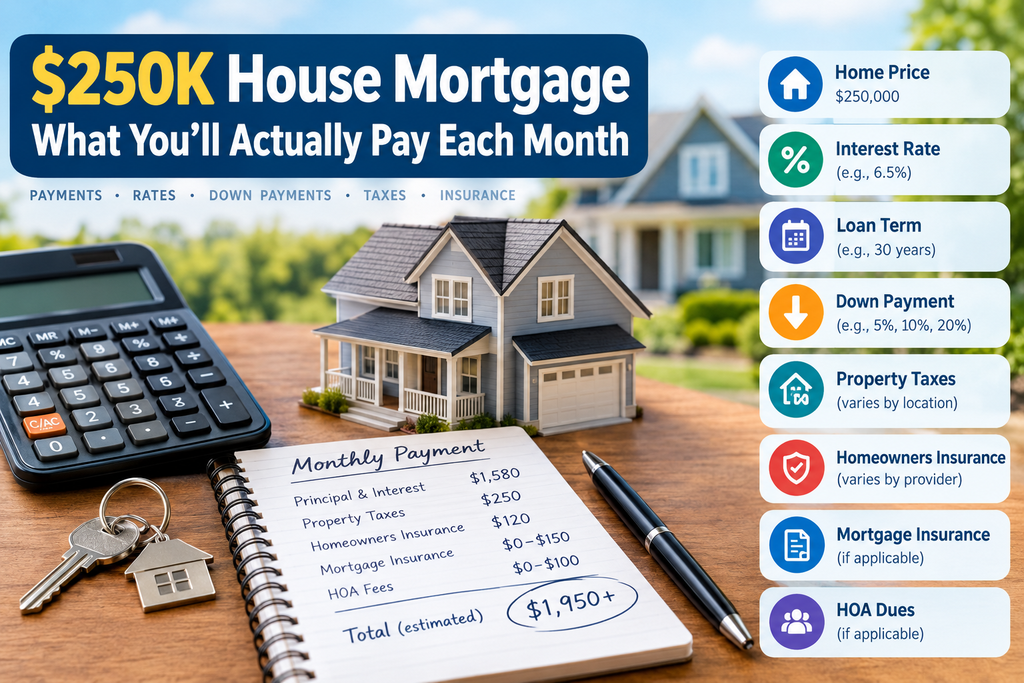
If you are searching for a 250k house mortgage, the first number you probably want is the monthly payment. For a $250,000 mortgage at 6.5% interest for 30 years, the principal and interest payment is about $1,580 per month. That number does not include property taxes, homeowners insurance, mortgage insurance, or HOA dues, so your actual housing payment could be considerably higher. If you are buying a $250,000 house and putting 20% down, your loan would be $200,000, and the principal and interest payment at 6.5% for 30 years would be about $1,264 per month. Your final payment depends heavily on the loan amount, interest rate, down payment, property taxes, insurance, mortgage insurance, and other costs.
For context, Freddie Mac reported an average 30 year fixed mortgage rate of 7.28% and an average 15 year fixed rate of 6.60% on October 1, 2026. Those are market averages, not a quote for an individual borrower, and your offered rate can be different based on factors such as credit, loan type, down payment, lender, property, and other underwriting considerations.
| Scenario | Loan Amount | Rate | Term | Principal and Interest |
|---|---|---|---|---|
| $250K mortgage | $250,000 | 6.5% | 30 years | About $1,580 |
| $250K mortgage | $250,000 | 6.5% | 15 years | About $2,178 |
| $250K house, 5% down | $237,500 | 6.5% | 30 years | About $1,501 |
| $250K house, 10% down | $225,000 | 6.5% | 30 years | About $1,422 |
| $250K house, 20% down | $200,000 | 6.5% | 30 years | About $1,264 |
The important distinction is simple: a $250K house does not necessarily mean a $250K mortgage. Your down payment determines how much you actually borrow.
“250K House” vs “250K Mortgage”: What Is the Difference?
This is one of the biggest sources of confusion when people search for 250k mortgage payment information. A $250,000 house refers to the purchase price of the property. A $250,000 mortgage refers to the amount you borrow from the lender. If you purchase a $250,000 home with $50,000 down, you are not taking out a $250,000 mortgage. Your mortgage would initially be $200,000, before considering any financed costs.
The difference matters because interest is charged on the amount you borrow. Imagine buying a $250,000 house with no down payment. Your starting loan could be $250,000, assuming the loan program and lender allow that structure. At 6.5% over 30 years, the principal and interest payment is approximately $1,580. Put $25,000 down instead, and the loan falls to $225,000, reducing principal and interest to about $1,422. With a $50,000 down payment, the loan becomes $200,000 and the principal and interest payment falls to roughly $1,264.
Here is how those numbers compare using a 6.5% 30 year fixed example:
| Home Price | Down Payment | Mortgage Amount | Approx. Monthly P&I |
|---|---|---|---|
| $250,000 | $0 | $250,000 | $1,580 |
| $250,000 | $12,500 | $237,500 | $1,501 |
| $250,000 | $25,000 | $225,000 | $1,422 |
| $250,000 | $50,000 | $200,000 | $1,264 |
These figures show why searching only for the purchase price can give you the wrong answer. When you use a 250k mortgage calculator, always check whether you are entering the home’s purchase price or the actual loan amount.
$250K Mortgage Payment by Interest Rate and Loan Term
Interest rate can change your monthly payment by hundreds of dollars. For example, a $250,000 loan at 5.5% for 30 years produces a principal and interest payment of about $1,419 per month. At 7.5%, that payment rises to approximately $1,748. The difference is around $329 every month, or nearly $4,000 per year. Over a long mortgage, even relatively small rate changes can have a substantial effect on the total interest you pay.
The loan term matters just as much. A 15 year mortgage generally requires a much larger monthly payment, but you pay the loan down much faster and normally pay substantially less interest over the life of the loan. A 30 year mortgage spreads repayment over twice as many years, making the monthly payment easier to manage but increasing the total interest cost.
| Interest Rate | 30 Year Payment | 15 Year Payment |
|---|---|---|
| 5.5% | $1,419 | $2,043 |
| 6.0% | $1,499 | $2,110 |
| 6.5% | $1,580 | $2,178 |
| 7.0% | $1,663 | $2,247 |
| 7.5% | $1,748 | $2,318 |
These are principal and interest on a 250k mortgage only. They do not include property taxes, homeowners insurance, mortgage insurance, HOA dues, or other housing expenses.
Because mortgage rates move over time, a calculator page should be updated regularly rather than presenting one rate as if it will apply to every borrower. Freddie Mac’s October 1, 2026 survey illustrates how quickly rates can move, with the 30 year average rising from 7.03% on September 24 to 7.28% one week later.
Use a 250K Mortgage Calculator Before You Buy
A 250k mortgage calculator is useful because the monthly payment is only one part of the affordability equation. You should be able to enter the home price, down payment, interest rate, loan term, estimated property tax, homeowners insurance, and mortgage insurance when applicable. That gives you a much more realistic estimate than simply calculating principal and interest. A good calculator should also let you change one assumption at a time so you can see exactly what happens when the interest rate or down payment changes.
For example, suppose you are looking at a $250,000 home and considering either 5% or 20% down. At 6.5%, the principal and interest payment falls from about $1,501 with a $237,500 loan to about $1,264 with a $200,000 loan. That is roughly $237 per month before considering the possible effect of mortgage insurance. If your down payment is below 20%, mortgage insurance may also increase the monthly cost. The CFPB explains that mortgage insurance is typically required when a borrower puts less than 20% down, although requirements vary by loan type and circumstances.
A calculator is most valuable when you test several realistic scenarios rather than searching for one magic number. Try your expected down payment, a conservative interest rate, realistic taxes and insurance, and your existing monthly debts. Then compare the result with your actual household budget.
What Is Included in Your Real Monthly Mortgage Payment?
The phrase 250k mortgage payment can be misleading because people often mean only principal and interest. Your real monthly housing cost can contain several additional components. The CFPB explains that monthly mortgage costs can include principal, interest, mortgage insurance, property taxes, and homeowners insurance, while HOA fees may be separate depending on the property and payment arrangement.
Principal is the portion of your payment that reduces what you owe. Interest is the cost of borrowing the money. Property taxes go to your local government, while homeowners insurance protects against covered losses associated with the property. Mortgage insurance can apply when your down payment is below certain thresholds or when the loan program requires it.
Consider a $250,000 house with 20% down. Your mortgage would be $200,000. At 6.5% for 30 years, principal and interest would be approximately $1,264. Now imagine estimated property taxes of $250 per month and homeowners insurance of $120 per month. Your estimated payment would become about $1,634 before HOA dues.
If the same buyer had a smaller down payment, mortgage insurance could push the total higher. That is why saying “the payment is $1,580” without explaining what is included can be misleading. The number is accurate for a particular principal and interest calculation, but it is not necessarily the amount that will leave your bank account each month.
How Much Income Do You Need for a $250K House?
A $250K house may be affordable for one household and uncomfortable for another. Income is important, but lenders also look at existing debts, credit history, assets, down payment, loan type, and other factors. One commonly used affordability guideline is the 28% rule, which suggests keeping the mortgage payment around 28% or less of gross income. Fannie Mae presents the 28% and 36% rules as general affordability guidelines rather than guarantees of approval.
For example, suppose your estimated housing payment is $1,634 per month. Dividing that by 28% gives a gross monthly income requirement of roughly $5,836, or about $70,000 per year. That does not mean someone earning less than $70,000 automatically cannot buy a $250,000 home. It means the payment would consume a larger share of gross income and could become more difficult depending on other debts and expenses.
Fannie Mae’s current underwriting guidance also shows that DTI limits can vary according to underwriting method and borrower circumstances. Its guidance lists 36% as the maximum total DTI for manually underwritten loans, with higher ratios possible in specified circumstances, while automated underwriting can permit higher ratios.
Can You Afford a $250K House on a $50K Salary?
A $50,000 annual salary equals about $4,167 in gross monthly income. Using the 28% guideline, that produces a housing target of roughly $1,167 per month. A $250,000 home may therefore feel tight if the required payment is substantially above that amount, especially if you have a car payment, student loan, credit card balance, childcare costs, or other recurring expenses.
The answer is not simply yes or no. A large down payment could reduce the mortgage considerably. A lower interest rate could also reduce the payment. On the other hand, high property taxes, insurance, HOA fees, or other debts could make the same house less comfortable.
Can You Afford a $250K House on a $60K Salary?
With a $60,000 annual income, gross monthly income is about $5,000. At 28%, the guideline produces approximately $1,400 in monthly housing costs. That is close to the principal and interest payment on a $225,000 loan at 6.5%, but it does not leave room for taxes and insurance unless the overall financial picture is favorable.
This is why the difference between a $250,000 purchase price and a $250,000 mortgage matters. A buyer who puts 10% down has a smaller loan than someone financing the full purchase price. The smaller loan can make the monthly principal and interest payment more manageable.
Can You Afford a $250K House on a $70K Salary?
At $70,000 per year, gross monthly income is approximately $5,833. Twenty eight percent is about $1,633 per month. That is almost exactly the illustrative $1,634 housing payment used earlier for a $250,000 house with 20% down, 6.5% interest, estimated taxes of $250, and insurance of $120.
That comparison is useful, but it should not be treated as an approval formula. Your other debts matter. A household with no significant recurring debt can have a very different financial position from a household earning the same salary but carrying substantial monthly obligations.
Down Payment Options for a $250K House
The down payment is one of the most powerful variables in a 250k house mortgage calculation. A larger down payment means borrowing less, which generally reduces principal and interest. It can also affect mortgage insurance and potentially the interest rate and loan costs you receive. The CFPB notes that larger down payments can reduce loan costs and that putting at least 20% down can produce the greatest savings in many situations.
For a $250,000 home, the numbers look like this:
| Down Payment | Cash Down | Starting Loan |
|---|---|---|
| 20% | $50,000 | $200,000 |
| 10% | $25,000 | $225,000 |
| 5% | $12,500 | $237,500 |
| 3.5% | $8,750 | $241,250 |
| 0% | $0 | $250,000 |
A 3.5% down payment is commonly associated with FHA financing for eligible borrowers. HUD states that FHA down payments can be as low as 3.5% of the purchase price.
Some eligible buyers may also qualify for loan programs that permit very low or even zero down payments. The important point is not that one down payment is always best. Keeping more cash available for emergencies can be valuable, while putting more money down can reduce borrowing costs. The right choice depends on your financial position rather than a universal rule.
What Is the Total Interest on a $250K Mortgage?
The total interest paid on a 250k mortgage can be surprisingly large, particularly with a 30 year loan. At 6.5%, a $250,000 mortgage over 30 years has an estimated principal and interest payment of about $1,580 per month. Multiplying that payment by 360 monthly payments gives approximately $568,861 in total principal and interest. Since $250,000 of that is the original principal, roughly $318,861 would be interest over the full term if the loan stayed at 6.5% for the entire 30 years.
A 15 year mortgage produces a dramatically different result. At 6.5%, the payment is approximately $2,178 per month. Across 180 payments, total principal and interest would be about $391,998, meaning roughly $141,998 would be interest.
| Loan | Rate | Term | Monthly P&I | Total Interest |
|---|---|---|---|---|
| $250,000 | 6.5% | 30 years | $1,580 | About $318,861 |
| $250,000 | 6.5% | 15 years | $2,178 | About $141,998 |
The 15 year loan therefore saves roughly $176,863 in interest in this example, but requires about $598 more every month. That is the fundamental tradeoff. You are effectively choosing between a higher monthly commitment and a much lower long term borrowing cost.
Understanding a $250K Mortgage Amortization Schedule
A 250k mortgage amortization schedule shows how every scheduled payment is divided between interest and principal. Early in the loan, a larger portion of your payment goes toward interest because your outstanding balance is still high. As the balance falls, the interest portion gradually becomes smaller and more of your payment goes toward principal.
This can feel strange at first. You might make a $1,580 payment and discover that only part of it reduced your loan balance. That is normal for a long mortgage. Interest is calculated based on the remaining balance, so the interest portion naturally changes as the balance decreases.
For a 30 year $250,000 mortgage at 6.5%, the first payment is approximately $1,580. About $1,354 represents interest, while roughly $226 reduces principal. Over time, that relationship changes. Near the end of the mortgage, the interest portion is much smaller and most of the payment goes toward principal.
An amortization schedule is useful because it turns a large 30 year commitment into a month by month picture. If you are considering making extra payments, it also helps you see how additional principal payments can shorten the repayment period and reduce future interest.
15 Year vs 30 Year: Which Makes More Sense?
Choosing between a 15 year and 30 year mortgage is not simply a question of which payment is lower. A 250k mortgage payment 15 year option can save a substantial amount of interest, but the required monthly payment is much higher. A 30 year mortgage offers more breathing room each month, which can be valuable if you want to maintain emergency savings or have other financial priorities.
| Factor | 15 Year Mortgage | 30 Year Mortgage |
|---|---|---|
| Monthly payment | Higher | Lower |
| Total interest | Much lower | Much higher |
| Equity buildup | Faster | Slower |
| Cash flow flexibility | Lower | Higher |
| Best for | Buyers comfortable with higher payments | Buyers prioritizing lower monthly costs |
At 6.5%, the illustrative $250,000 loan requires about $2,178 per month over 15 years compared with about $1,580 over 30 years. The difference is nearly $598 every month.
A 15 year loan can make sense when your income is strong and stable and the higher payment does not interfere with other financial goals. A 30 year mortgage may make more sense when keeping the monthly obligation lower gives you greater flexibility. Neither term is automatically the right answer for every buyer.
What Are the Hidden Costs Beyond the Mortgage?
The mortgage is only one part of the money required to buy a home. You also need to think about closing costs, inspections, moving expenses, initial repairs, furnishings, utility deposits, property taxes, insurance, and ongoing maintenance. The CFPB says closing costs typically range from 2% to 5% of the purchase price, excluding the down payment, although the actual amount varies by transaction.
For a $250,000 home, 2% would be approximately $5,000 and 5% would be approximately $12,500. Those costs are in addition to your down payment. A buyer putting 20% down could therefore need around $50,000 for the down payment plus potentially $5,000 to $12,500 or more in closing costs and other upfront expenses.
Your first year also deserves attention. A new homeowner may suddenly face a broken appliance, plumbing issue, landscaping expense, insurance deductible, or other repair. The CFPB specifically recommends keeping money available for initial home expenses, moving costs, utility setup, and an emergency cushion rather than putting every available dollar into the down payment.
Thinking about the full cash requirement before making an offer can prevent an uncomfortable situation where you technically qualify for the house but have very little cash left after closing.
How to Lower Your $250K Mortgage Payment
There are several ways to reduce the cost of a 250k house mortgage, but each approach has a tradeoff. The simplest is usually increasing the down payment. Borrowing $200,000 instead of $250,000 at the same interest rate obviously produces a smaller principal and interest payment. A larger down payment may also reduce or eliminate conventional mortgage insurance, depending on the loan structure.
Shopping lenders can also matter. Two lenders can offer different interest rates, fees, points, and loan terms. Comparing only the advertised interest rate can therefore miss part of the picture. The CFPB recommends looking at the overall cost of the mortgage, including upfront and ongoing costs.
Buying discount points is another option. Points are upfront charges paid to the lender in exchange for a lower interest rate. Whether points make sense depends on how much they cost, how much they reduce the rate, and how long you expect to keep the loan.
Extra principal payments can also reduce future interest. Even a recurring additional payment can change the amortization path, although you should check the terms of your loan before making assumptions about how extra payments are applied.
$250K vs $200K vs $300K Mortgage
Comparing different loan sizes is a quick way to understand how much the purchase price can affect your budget. At the same 6.5% rate and 30 year term, the payment scales with the amount borrowed.
| Mortgage Amount | Rate | Term | Approx. P&I |
|---|---|---|---|
| $200,000 | 6.5% | 30 years | $1,264 |
| $250,000 | 6.5% | 30 years | $1,580 |
| $300,000 | 6.5% | 30 years | $1,896 |
Moving from a $200,000 mortgage to a $250,000 mortgage adds approximately $316 per month in principal and interest. Moving from $250,000 to $300,000 adds another approximately $316.
This comparison is especially helpful if you are deciding how much house to buy. Instead of asking only, “What price can I qualify for?” ask, “What payment fits comfortably into my monthly budget?” Qualification and comfort are not necessarily the same thing.
Key Takeaways Before You Get a $250K Mortgage
A 250k house mortgage can produce very different monthly payments depending on the down payment, interest rate, loan term, property taxes, insurance, mortgage insurance, and HOA costs. For a straightforward example, $250,000 borrowed at 6.5% for 30 years produces approximately $1,580 in principal and interest. The same amount borrowed over 15 years produces approximately $2,178, but the total interest cost is dramatically lower.
If you are buying a $250,000 home rather than borrowing $250,000, your actual mortgage could be much smaller. With 20% down, for example, you would borrow $200,000, producing an estimated principal and interest payment of about $1,264 at 6.5% for 30 years. Your real housing payment would then include applicable taxes, homeowners insurance, and potentially other costs.
The most useful next step is to run your own numbers using the actual purchase price, down payment, expected rate, loan term, estimated taxes, insurance, and mortgage insurance. That gives you a much more realistic picture than relying on a generic mortgage payment number.
Conclusion
A $250K mortgage is not one fixed monthly payment. At 6.5% on a 30 year fixed loan, $250,000 of borrowing produces a principal and interest payment of about $1,580 per month. At the same rate over 15 years, the payment rises to about $2,178, but the total interest falls dramatically. If instead you are buying a $250,000 home and putting 20% down, you would start with a $200,000 mortgage and an estimated principal and interest payment of about $1,264.
The biggest mistake is stopping at principal and interest. Your actual monthly housing expense can include property taxes, homeowners insurance, mortgage insurance, and possibly HOA dues. Your upfront budget also needs to account for the down payment and closing costs. The CFPB states that closing costs commonly range from 2% to 5% of the purchase price, excluding the down payment.
The right mortgage is therefore not necessarily the largest loan a lender will approve. It is the payment you can handle while still maintaining savings, covering your other obligations, and dealing with the ordinary surprises that come with owning a home. Use the 250k mortgage calculator to test different rates, down payments, and loan terms before deciding what fits your budget.
Frequently Asked Questions
What is the monthly payment on a $250,000 mortgage?
At 6.5% interest on a 30 year fixed mortgage, a $250,000 loan has an estimated principal and interest payment of approximately $1,580 per month. This does not include property taxes, homeowners insurance, mortgage insurance, or HOA dues. At different interest rates, the payment changes significantly. For example, at 6%, the principal and interest payment is about $1,499, while at 7% it is about $1,663.
How much do I need to earn to afford a $250K house?
There is no single income requirement because affordability depends on your down payment, interest rate, taxes, insurance, other debts, credit profile, and loan type. As a general planning example, if your total housing cost were around $1,633 per month, the 28% guideline would imply gross annual income of roughly $70,000. The 28% guideline is only a starting point, not a guarantee of mortgage approval or affordability.
How much down payment do I need for a $250K house?
The amount depends on the mortgage program and lender. A 20% down payment would be $50,000, while 10% would be $25,000, 5% would be $12,500, and 3.5% would be $8,750. FHA financing can allow a 3.5% down payment for eligible borrowers. Some loan programs may allow lower or zero down payments for qualifying buyers.
Do I need PMI on a $250K house?
You may need mortgage insurance if you make a smaller down payment, depending on the type of mortgage. Conventional borrowers who put less than 20% down commonly have mortgage insurance, while FHA and some other government backed loans have their own mortgage insurance requirements. Mortgage insurance increases the overall cost of borrowing, so it should be included when calculating your real monthly payment.
How much are closing costs on a $250K home?
A common planning range is 2% to 5% of the purchase price, excluding the down payment. On a $250,000 home, that is approximately $5,000 to $12,500. Actual costs can be higher or lower depending on the lender, location, loan type, services, taxes, prepaid expenses, and other transaction details.
What is the total cost of a $250K mortgage over 30 years?
At 6.5%, a $250,000 mortgage over 30 years has an estimated principal and interest payment of about $1,580 per month. Across 360 payments, that works out to approximately $568,861 in total principal and interest, including the original $250,000 principal. That means approximately $318,861 in interest over the full term, before adding property taxes, homeowners insurance, mortgage insurance, HOA fees, and other costs.