If you are searching for what percent is a number of another number, the calculation is usually much easier than it first appears. You only need to identify the number you are comparing, identify the reference number, divide the first number by the second number, and multiply by 100.
The basic formula is:
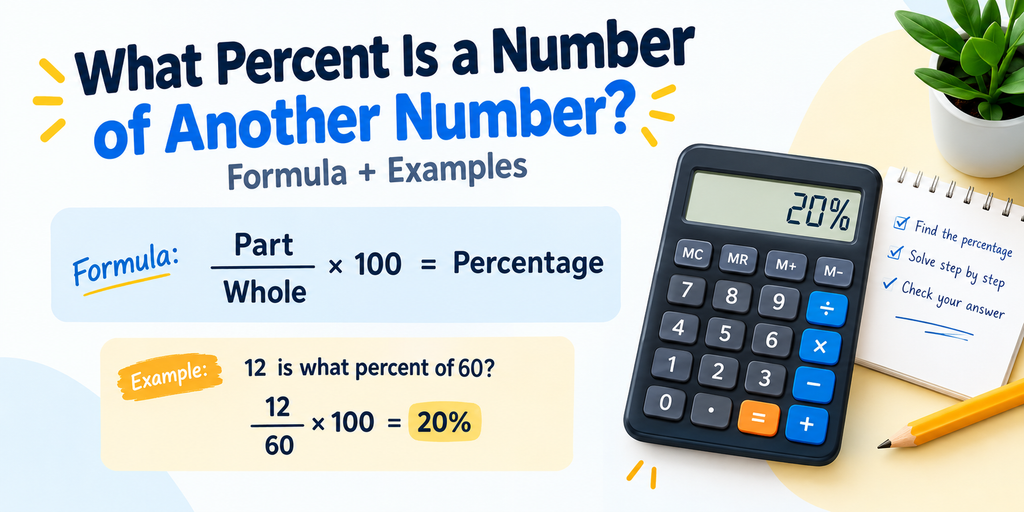
Percentage = (Part ÷ Whole) × 100
For example, if you want to know 12 is what percent of 60, divide 12 by 60 and multiply the result by 100:
(12 ÷ 60) × 100 = 20%
So, 12 is 20% of 60.
This formula works for test scores, discounts, budgets, sales figures, statistics, sports results, measurements, and countless everyday calculations. The most important part is not the multiplication. It is correctly identifying which number is the part and which number is the whole.
Quick Answer: How to Find What Percent One Number Is of Another
To find what percentage one number is of another, divide the number you are comparing by the reference number and multiply by 100.
Formula:
Percentage = (Part ÷ Whole) × 100
For example:
25 is what percent of 50?
First divide:
25 ÷ 50 = 0.5
Then multiply by 100:
0.5 × 100 = 50
Therefore:
25 is 50% of 50.
A useful way to remember the formula is to connect the wording of the question with the calculation. In a question such as “25 is what percent of 50?”, 25 is the part and 50 is the whole. The number after the word “of” is normally the reference amount in this type of percentage question. Once you recognize that pattern, many percentage problems become almost automatic.
This same relationship can also be written as a proportion:
Part ÷ Whole = Percentage ÷ 100
The proportion and the standard formula are simply two ways of expressing the same mathematical relationship.
The Percentage Formula Explained
The central formula for finding what percent one number is of another is:
Percentage = (Part ÷ Whole) × 100
A percentage expresses a ratio in terms of 100. For example, 50% means 50 out of 100, while 25% means 25 out of 100. When you divide a part by its whole, you get a decimal representation of that relationship. Multiplying by 100 changes that decimal into a percentage.
Suppose you have 30 apples out of a total of 120 apples. You want to know what percentage of the apples are in your selected group.
The calculation is:
(30 ÷ 120) × 100
First:
30 ÷ 120 = 0.25
Then:
0.25 × 100 = 25%
So, 30 is 25% of 120.
The formula is also useful because it separates the problem into two simple ideas. Division tells you how large the part is compared with the whole, while multiplication by 100 expresses that relationship on a percentage scale.
What Do “Part” and “Whole” Mean?
The part is the number being compared. The whole is the number used as the reference point.
Consider this question:
18 is what percent of 72?
Here, 18 is the part because it is the amount being measured. The number 72 is the whole because it represents the complete reference amount.
Therefore:
Percentage = (18 ÷ 72) × 100
Percentage = 25%
The same idea appears in a test score. If a student gets 42 questions correct out of 50, the 42 is the part and 50 is the whole.
(42 ÷ 50) × 100 = 84%
The student scored 84%.
This distinction is extremely important because changing the denominator changes the meaning of the answer. For example, 30 is 60% of 50, but 50 is only 166.67% of 30. Both calculations can be mathematically correct, but they answer different questions.
When you see a percentage question, pause for a second before calculating. Ask yourself, “Which number am I measuring, and what number am I measuring it against?” That simple habit prevents one of the most common percentage errors.
Why the Word “Of” Matters
The word “of” is an important clue in percentage problems.
Consider:
20 is what percent of 80?
The word “of” introduces the reference number, so 80 is the whole.
You calculate:
20 ÷ 80 × 100 = 25%
Therefore, 20 is 25% of 80.
This is different from a question such as:
20 is what percent more than 80?
That question is asking about percentage change, not simply the percentage one number represents of another.
The reference point changes the calculation. For a basic “what percent is one number of another” question, use:
Part ÷ Whole × 100
For percentage increase or decrease, you compare the difference with the original or reference value.
Learning to recognize the wording is often more valuable than memorizing several unrelated formulas. Once you know what the question is actually asking, the correct calculation becomes much easier to choose.
How to Calculate a Percentage Step by Step
If you want a reliable method for finding what percent one number is of another, use four simple steps. The method works whether the numbers are whole numbers, decimals, fractions, marks, prices, quantities, or measurements.
Imagine the question is:
36 is what percent of 90?
You can solve it as follows.
Step 1: Identify the Part and Whole
The first task is to determine which number represents the part and which represents the whole.
In:
36 is what percent of 90?
36 is the part.
90 is the whole.
This gives you:
Part = 36
Whole = 90
Step 2: Divide the Part by the Whole
Now divide the part by the whole:
36 ÷ 90 = 0.4
At this stage, you have a decimal rather than a percentage.
Step 3: Multiply by 100
Convert the decimal into a percentage:
0.4 × 100 = 40
Add the percentage symbol:
40%
Therefore:
36 is 40% of 90.
This four step approach is simple enough for mental practice but also reliable when working with a calculator. The key is to keep the order correct. If you divide 90 by 36 instead, you are answering a different question.
Worked Examples of Finding a Percentage
The best way to understand what percentage one number is of another is to work through examples with different types of numbers. Some percentage questions produce a neat whole number, while others produce a decimal or a result above 100%.
Simple Example: 8 Is What Percent of 40?
Start with:
8 is what percent of 40?
Identify the part and whole:
Part = 8
Whole = 40
Apply the formula:
(8 ÷ 40) × 100
Divide:
8 ÷ 40 = 0.2
Multiply:
0.2 × 100 = 20%
Therefore:
8 is 20% of 40.
You can also understand this intuitively. Forty can be divided into five equal groups of eight. One group out of five represents one fifth, and one fifth is equal to 20%.
Decimal Example: 12.5 Is What Percent of 200?
Decimals do not change the formula.
Question:
12.5 is what percent of 200?
Use:
(12.5 ÷ 200) × 100
First:
12.5 ÷ 200 = 0.0625
Then:
0.0625 × 100 = 6.25%
Therefore:
12.5 is 6.25% of 200.
This example shows why it is useful not to round too early. If you rounded 0.0625 before multiplying by 100, you could lose accuracy.
When the Answer Is More Than 100%
A percentage does not have to be below 100%.
Consider:
60 is what percent of 40?
Apply the formula:
(60 ÷ 40) × 100
60 ÷ 40 = 1.5
1.5 × 100 = 150%
Therefore:
60 is 150% of 40.
This makes sense because 60 is one and a half times 40.
A result above 100% simply tells you that the part being compared is larger than the reference whole. The formula has not failed. The answer is correctly showing the relationship between the two numbers.
For example, if one company has 150 customers and another reference group has 100 customers, then 150 customers is 150% of 100 customers.
Reverse Percentage Problems
Not every percentage question asks you to find the percentage. Sometimes the percentage and whole are already known, and you need to find the part. Other times you know the part and percentage but need to find the original whole.
These questions are related, but the formulas are arranged differently.
Finding a Percentage of a Number
Suppose you want to find:
25% of 80
This is not the same as asking:
20 is what percent of 80?
Here, the percentage is already given. You need to find the part.
Use:
Part = (Percentage ÷ 100) × Whole
Therefore:
Part = (25 ÷ 100) × 80
Part = 0.25 × 80
Part = 20
So, 25% of 80 is 20.
The distinction is important. “What percent is one number of another?” asks you to find the percentage. “What is a certain percentage of a number?” asks you to find the part.
Finding the Whole When the Part and Percentage Are Known
Now consider:
20 is 25% of what number?
This time, you know the part and the percentage, but the whole is missing.
Use:
Whole = Part ÷ (Percentage ÷ 100)
Substitute the values:
Whole = 20 ÷ 0.25
Whole = 80
Therefore:
20 is 25% of 80.
You can check the answer by calculating 25% of 80:
0.25 × 80 = 20
The original statement is correct.
These three basic percentage questions can therefore be summarized as follows:
| What are you finding? | Formula |
|---|---|
| Percentage | Part ÷ Whole × 100 |
| Part | Percentage ÷ 100 × Whole |
| Whole | Part ÷ (Percentage ÷ 100) |
Understanding this relationship is much better than memorizing formulas separately because all three come from the same basic percentage equation.
Percentage Increase and Decrease
A common source of confusion is the difference between what percentage one number is of another and what percentage one number is more or less than another.
Suppose a price increases from 80 to 100.
If you ask:
100 is what percent of 80?
The calculation is:
(100 ÷ 80) × 100 = 125%
So, 100 is 125% of 80.
But if you ask:
What percentage did the price increase from 80 to 100?
Now you calculate the change first:
100 − 80 = 20
Then compare that change with the original value:
(20 ÷ 80) × 100 = 25%
So the price increased by 25%.
The two answers are different because the questions are different.
For percentage increase:
Percentage Increase = ((New Value − Original Value) ÷ Original Value) × 100
For percentage decrease:
Percentage Decrease = ((Original Value − New Value) ÷ Original Value) × 100
The original value is important because it provides the reference point for measuring the change.
Common Percentage Mistakes to Avoid
Percentage problems are usually not difficult because of complicated arithmetic. They are difficult because a small wording mistake can change the entire setup.
The first common mistake is swapping the part and whole. If the question says “15 is what percent of 60,” the correct calculation is 15 divided by 60, not 60 divided by 15. The denominator represents the reference amount.
The second mistake is forgetting to multiply by 100. If you calculate 15 ÷ 60 and get 0.25, that is the decimal form of the ratio. The percentage is 25%, so the decimal must be converted to a percentage.
Another common mistake is confusing percent of with percent more than. Saying 120 is 120% of 100 is correct. Saying 120 is 20% more than 100 is also correct. They describe different relationships, so the wording matters.
Rounding too early can cause another problem. If a calculation produces several decimal places, keep the extra precision until the final step and round the final percentage according to the level of accuracy you need.
Finally, remember that the whole cannot be zero in the basic formula. Division by zero is undefined, so a question asking what percentage a number is of zero does not have a standard percentage answer.
Percentage Calculator and Quick Method
For repeated calculations, a percentage calculator can save time, but understanding the formula means you can also check whether a calculator result makes sense.
For a basic what percent is one number of another calculation, enter:
Part = the number being compared
Whole = the reference number
Then calculate:
Part ÷ Whole × 100
For example, if the inputs are:
Part: 45
Whole: 60
The calculation is:
45 ÷ 60 × 100 = 75%
The answer is 75%.
A useful mental shortcut is to look for familiar fractions. If the part is half the whole, the answer is 50%. If it is one quarter, the answer is 25%. If it is three quarters, the answer is 75%. Recognizing these relationships can make simple percentage calculations much faster without a calculator.
For less familiar numbers, use the standard formula rather than trying to force a mental shortcut. Accuracy matters more than speed.
Real Life Uses of Percentage Calculations
Percentages appear almost everywhere numbers are used to compare quantities.
Grades and test scores are one of the clearest examples. If a student answers 45 out of 60 questions correctly, the percentage is:
(45 ÷ 60) × 100 = 75%
This converts a raw score into a standardized result that is easier to understand.
Discounts also rely on percentages. If an item costs $80 and a store offers a 20% discount, the discount amount is:
0.20 × $80 = $16
The final price before any additional charges is $64.
Tips and service charges use the same basic percentage relationship. A 15% tip on a $40 bill is:
0.15 × $40 = $6
Budgets can also be expressed as percentages. If someone spends $300 on housing from a monthly income of $1,500, housing represents:
(300 ÷ 1,500) × 100 = 20%
Sports statistics are another everyday application. If a basketball player makes 18 shots out of 30 attempts, the shooting percentage is:
(18 ÷ 30) × 100 = 60%
The same calculation can be used for completion rates, success rates, attendance, sales performance, survey results, and many other situations.
The advantage of percentages is that they put different sized quantities onto the same scale. Comparing 18 out of 30 with 72 out of 120 is easier when both are converted to percentages. In both cases, the result is 60%.
What Does It Mean When U Is 90 Percent Less Than V?
The statement “U is 90 percent less than V” is a percentage decrease statement.
If V represents the original amount, then being 90% less means 90% of V has been removed.
The remaining amount is:
100% − 90% = 10%
Therefore:
U = 10% of V
In formula form:
U = 0.10V
For example, if:
V = 200
then:
U = 0.10 × 200
U = 20
So U is 20 when V is 200.
This wording is different from saying “U is 90% of V.” If U is 90% of V, then only 10% has been removed. If U is 90% less than V, U is only 10% of V.
That distinction is important because percentage decrease statements describe the amount removed relative to the original value. When you encounter phrases such as 90 percent less, 50 percent less, or 20 percent less, identify the original reference value before doing the calculation.
Conclusion
Knowing what percent is a number of another number comes down to one central formula:
Percentage = (Part ÷ Whole) × 100
The hardest part is usually identifying the correct part and whole. Once those two numbers are in the right places, the calculation is straightforward.
For example, if you need to find what percentage 30 is of 120, calculate:
(30 ÷ 120) × 100 = 25%
Remember that the number being compared goes in the numerator, while the reference amount goes in the denominator. Also pay attention to the wording because “percent of,” “percent more,” and “percent less” describe different mathematical relationships.
The same basic percentage relationship can help you solve test score questions, discounts, tips, budgets, sports statistics, sales figures, growth rates, and many other everyday problems. Once you become comfortable recognizing the type of percentage question you are looking at, these calculations become much quicker and easier.
Frequently Asked Questions
What percent is X of Y?
To find what percent X is of Y, divide X by Y and multiply by 100.
Percentage = (X ÷ Y) × 100
For example, if X is 15 and Y is 60:
(15 ÷ 60) × 100 = 25%
Therefore, 15 is 25% of 60.
How do you find what percent one number is of another?
First identify the number being compared as the part and the reference number as the whole. Divide the part by the whole, then multiply the result by 100.
For example:
20 ÷ 80 × 100 = 25%
Therefore, 20 is 25% of 80.
What percent is 1 of 10?
Use the standard percentage formula:
(1 ÷ 10) × 100 = 10%
Therefore, 1 is 10% of 10.
Some other useful examples are 1 out of 20, which is 5%, and 1 out of 100, which is 1%.
What if the whole is 0?
The standard percentage formula requires division by the whole:
Part ÷ Whole × 100
If the whole is zero, you would have to divide by zero, which is undefined in standard arithmetic. Therefore, a normal percentage cannot be calculated when the reference whole is zero.
Can a percentage be greater than 100%?
Yes. A percentage can be greater than 100% when the part is larger than the whole.
For example:
60 ÷ 40 × 100 = 150%
Therefore, 60 is 150% of 40.
A result above 100% simply means the number being compared is greater than the reference amount.