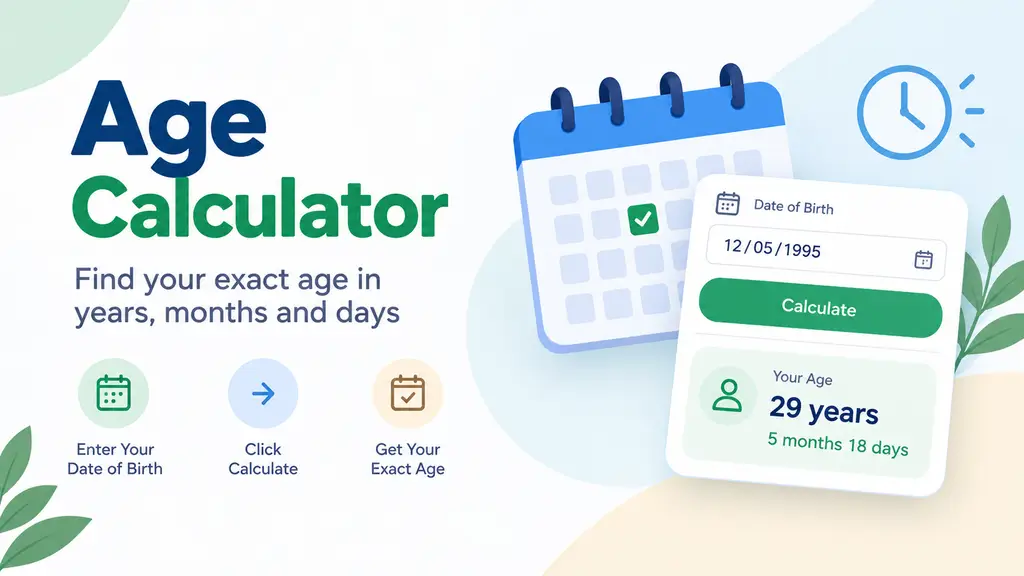
Have you ever looked at a photo and wondered, “How old do I actually look?” An AI age calculator can give you an estimate by analyzing visible characteristics in a face, while a traditional age calculator can tell you your exact chronological age from your date of birth. These two tools answer very different questions, but putting them together can make understanding age much more interesting.
A quick note before we go further: ToolsByMeh’s Age Calculator currently calculates exact chronological age from your date of birth, fast, free, and no photo needed. We don’t currently offer a photo-upload AI age estimator, but the rest of this guide explains how that kind of technology works and what to know if you try one elsewhere.
A photo based AI age estimate is not the same thing as knowing someone’s real age. Artificial intelligence looks for visual patterns and produces a prediction, while your date of birth provides a precise mathematical answer. Results can change because of lighting, facial expression, camera quality, glasses, makeup, and other factors. NIST testing has also shown that age estimation software can produce results that vary around a person’s actual age when facial expressions or glasses change.
The goal of an AI Age Calculator should therefore be simple: provide a quick estimate, explain what that estimate means, protect the user’s photo, and avoid pretending that an AI prediction is a medical or legal measurement.
How a Photo Based Age Estimator Typically Works
How Does an AI Age Calculator Work?
An AI age calculator generally works by taking information from a photograph and using a trained machine learning model to estimate an age or age range. The system first needs to identify the relevant face within the image. It can then process visual characteristics and convert those characteristics into numerical information that the model can use for its prediction.
Think of the process like a very complicated pattern matching exercise. A person looking at a face might notice skin texture, facial structure, visible lines, hair characteristics, and other cues before making a rough guess. An AI system does something fundamentally different in implementation, but the basic idea is similar: it uses patterns learned during training to produce an estimate from visual information.
A simplified process looks like this:
Photo → Face detection → Feature analysis → Machine learning model → Estimated age
The important word is estimated. The system does not discover a hidden number inside your face that contains your birth date. Instead, it calculates a prediction based on patterns represented in the model.
Training data matters enormously. An age estimation model learns from photographs that have associated age information, allowing it to find statistical relationships between facial appearance and age. NIST’s 2024 evaluation examined six age estimation algorithms and found that none clearly outperformed all the others, illustrating why users should be cautious about treating any individual AI estimate as exact.
The quality of the photograph also matters. A clear, front facing image gives the system more consistent visual information than a dark photograph taken from an extreme angle. Glasses, facial expressions and other changes can also affect estimates. NIST specifically demonstrated that changing facial expression and wearing or removing eyeglasses could cause age estimates to vary around the person’s true age.
Face Age vs. Chronological Age vs. Biological Age
People often use the words face age, chronological age, and biological age as though they mean the same thing. They do not. Understanding the difference is essential if you want to interpret an AI age calculator result responsibly.
| Type of age | What it measures | How it is estimated | Main purpose | Accuracy |
|---|---|---|---|---|
| Face age | Apparent age suggested by facial appearance | AI image analysis or human observation | Entertainment and general insight | An estimate |
| Chronological age | Time since birth | Date of birth and calendar calculation | Exact age calculation | Precise when dates are correct |
| Biological age | Indicators associated with aspects of physiological aging | Health, clinical, or research measurements | Research and health related assessment | Depends heavily on method |
Your chronological age is the simplest concept. If you were born on a particular date, your chronological age can be calculated from that date. It does not matter whether you look younger, older, tired, energetic, or completely different from what an AI model expects.
Face age is about appearance. A person can have a chronological age of 40 while an AI system estimates an apparent age of 35. Another person of the same chronological age could receive a different estimate because facial characteristics differ. That does not mean the first person is biologically younger or healthier.
Biological age is a separate concept again. It is sometimes used in research and health contexts to describe measures related to physiological aging, but it should not be inferred simply from a photograph. A face based AI tool cannot establish someone’s overall biological condition from appearance alone.
This is why an age result should be treated as a piece of information rather than a judgment. WHO defines healthy ageing around maintaining functional ability and well being, rather than simply looking younger.
How Accurate Is an AI Age Estimator?
The accuracy of an AI age estimator depends on the technology, training data, photograph, age group, and conditions under which the image was captured. There is no universal number such as “every AI age calculator is accurate within exactly three years.” Some commercial tools may advertise narrow error margins, but those claims should not automatically be treated as independent evidence.
Real world testing shows why caution is necessary. NIST’s 2024 evaluation found that age estimation algorithms can vary around a person’s actual age, and the organization examined differences caused by factors such as facial expression and eyeglasses. The evaluation also emphasized that age estimation performance varies among algorithms and applications.
A good photograph can improve consistency. A clear face facing the camera under even lighting gives the model a more stable input. By contrast, shadows, unusual angles, sunglasses, filters, heavy retouching, motion blur, or partial obstruction can remove useful visual information.
There is another important issue: demographic variation. AI systems learn from datasets, and the composition and quality of those datasets can influence performance across different groups. NIST research on face technologies has documented demographic differences in algorithm performance, demonstrating why responsible systems should be evaluated across relevant populations rather than assuming that one performance number applies equally to everyone.
For everyday curiosity, an age estimate can be fun and interesting. For decisions involving identity, legal age, healthcare, employment, or access to restricted services, a casual online Face Age Calculator should not be treated as sufficient proof.
How to Get the Most Accurate Result
If you want to try an AI photo age estimator, the quality of your input can make a noticeable difference. You do not need a professional camera or studio setup. The main objective is to give the model a clear and reasonably natural representation of the face.
- Use a clear photograph. Choose an image where your face is sharp and easy to see rather than blurry or heavily compressed.
- Face the camera naturally. A roughly front facing position gives the system a more consistent view of facial features.
- Use balanced lighting. Avoid extremely dark rooms or strong shadows crossing the face.
- Remove unnecessary obstructions. Sunglasses, large accessories, hands covering the face, or other objects can interfere with analysis.
- Avoid heavy filters. Beauty filters and aggressive photo editing can change the visual characteristics that the model is trying to evaluate.
- Use a natural expression. Since facial expressions can influence automated estimates, a relaxed expression may provide a more consistent input. NIST testing provides evidence that expression changes can affect estimated age.
These suggestions are not a guarantee of a correct result. They simply reduce avoidable sources of variation. An AI model is still making a statistical prediction, so two photographs of the same person can sometimes produce different answers.
It can actually be useful to treat that variation as part of the experiment. If one clear photograph produces an estimate of one age and another produces a slightly different estimate, that does not necessarily mean something changed about the person. It may simply show the uncertainty inherent in image based prediction.
Is an AI Age Calculator Safe? Your Photo and Privacy
Privacy should be one of the first questions you ask before uploading any photograph to an online AI age calculator. A face image is personal information, and the way a service handles that image depends on its own technical design and privacy practices.
There is no universal rule that every age calculator automatically deletes photos or refuses to use them for model training. Different services can have different policies. Some may process an image temporarily, while others may retain files for a stated period. Some may use third party processing infrastructure. Users therefore need to check the actual privacy policy of the specific tool they are using.
A privacy focused calculator should make important information easy to understand. Users should be able to find out whether photos are stored, how long they are retained, whether they are shared with service providers, and whether uploaded images can be used for improving models. If a website says that photos are not stored, that statement should reflect its actual technical operation.
There are also simple precautions users can take. Avoid uploading photographs containing other people when their permission is not available. Do not use an image containing unnecessary personal information in the background. Be cautious with websites that provide little information about who operates the service or what happens to uploaded files.
Privacy is not a minor technical detail. It is part of the quality of an online AI tool. A fast result is useful, but users should also understand what happens to the data that makes the result possible.
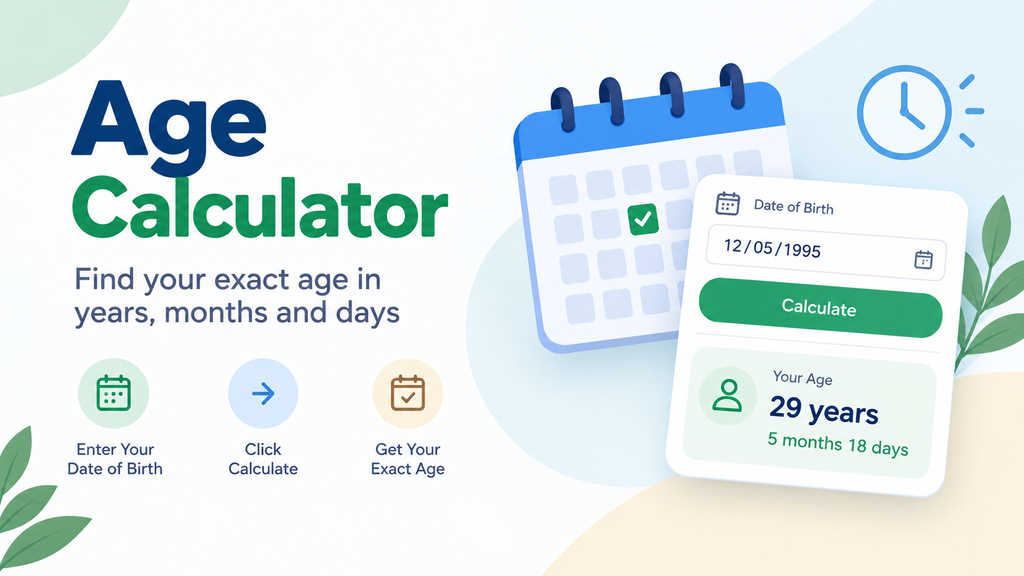
Calculate Your Exact Age From Your Date of Birth
If your real question is “How old am I?”, a chronological age calculator is more appropriate than an AI photo estimator. Entering your date of birth allows a calculator to determine the elapsed time between your birth date and the date being used for the calculation.
The result can be expressed in complete years, months, and days. For example, someone might be 27 years, 4 months, and 12 days old on a particular date. The calculation is based on calendar rules rather than visual appearance, so a photograph is unnecessary.
Leap years require careful handling. Someone born on February 29 has a birthday date that does not appear every calendar year, so software needs a defined approach when calculating age on dates during non leap years. A properly designed calculator should handle those calendar cases consistently rather than simply subtracting one year number from another.
Date calculations can also be more complicated than they first appear because months have different numbers of days. A calculation that simply converts a person’s total days alive into an approximate number of years and months may not produce the same result as a calendar based calculation. A good Simple Age Calculator based on date of birth therefore needs proper calendar logic.
Cultural systems can add another layer. Some traditional age counting systems have historically used conventions different from the internationally common chronological age system. That means a person may encounter different age expressions depending on the cultural or legal context. For everyday online calculators, the clearest approach is to explain exactly which age convention is being used.
What Can You Do to Look and Feel Younger?
An AI result that says you look older or younger should not become a reason to chase a particular appearance. Faces naturally change throughout life, and looking younger is not a reliable substitute for being healthy. If the real goal is healthy aging, evidence based habits matter much more than an image based number.
Regular physical activity is one of the clearest areas where evidence supports long term health. WHO states that physical activity provides important physical and mental health benefits and recommends that adults generally aim for at least 150 minutes of moderate intensity activity per week, or an equivalent amount of vigorous activity.
Nutrition matters as well. A varied diet containing nutrient dense foods can support health throughout life, and the National Institute on Aging identifies healthy eating as an important part of healthy aging.
Sleep should not be overlooked. The National Institute on Aging explains that good sleep supports mental and physical health, quality of life, and safety. Consistent sleep routines and addressing persistent sleep problems can therefore be much more meaningful for wellbeing than trying to manipulate a face based age score.
Sun protection can also be part of sensible skin care, particularly because long term ultraviolet exposure affects skin. Stress management, avoiding tobacco, staying physically active, eating a balanced diet, maintaining social connections, and keeping up with appropriate healthcare all contribute to broader healthy aging.
WHO emphasizes that healthy ageing is about developing and maintaining functional ability that supports wellbeing. That is a much bigger concept than looking a particular number of years younger in a photograph.
Can AI Age Estimation Be Used for Age Verification?
Age estimation and age verification are related, but they are not identical. Age estimation attempts to predict someone’s age from available information, such as facial characteristics. Age verification generally involves determining whether a person meets a particular age requirement.
This distinction becomes important when technology is used for age assurance. NIST’s 2024 evaluation specifically examined age estimation and verification technologies because such systems can potentially be used in situations where access depends on age.
A consumer AI Age Calculator should not be confused with an official identity document or legally recognized proof of age. A result such as “estimated age: 29” does not establish that a person’s chronological age is 29. It is a model prediction based on the available input.
For a platform that needs to enforce an age threshold, the technical requirements can be much stricter than those of a fun calculator. Error rates, demographic performance, privacy, security, consent, user experience, and applicable laws can all matter.
That is why a casual face age tool is best understood as an informational or entertainment tool. If an organization requires proof of age, users should follow the verification method officially provided by that organization rather than relying on an online photo estimate.
Related Calculators
An AI age calculator can be one useful part of a broader collection of calculators focused on health, personal planning, and everyday decisions. The important thing is to keep each calculator’s purpose clear so users understand what the result does and does not tell them.
A Biological Age Calculator can introduce users to the concept of physiological aging, although any biological age score depends heavily on the measurements and methodology used. It should not be presented as a diagnosis.
A Heart Age Calculator can provide an educational estimate based on selected cardiovascular risk factors. Such a result is not the same thing as a clinical cardiovascular assessment.
A BMI Calculator can calculate body mass index from height and weight. BMI is a screening measure rather than a complete description of an individual’s health.
An Ideal Weight Calculator can provide a numerical reference based on a selected formula, but the idea of one universally “ideal” weight is overly simplistic because health depends on many factors beyond a single number.
A Pregnancy Due Date Calculator serves a completely different purpose by estimating a due date from pregnancy dating information. Because pregnancy dating can involve clinical considerations, an online calculator should be treated as an estimate rather than a replacement for professional care.
Together, these tools can help users answer specific questions quickly. The strongest calculator experience is not the one that produces the most numbers. It is the one that explains what each number means, how it was calculated, and where its limitations begin.
Conclusion
An AI age calculator can be a fascinating way to estimate how old you appear in a photograph, but it cannot read your exact age from your face. Its result comes from patterns learned by a machine learning model, so factors such as lighting, facial expression, glasses, image quality, and the characteristics of the training data can influence the prediction. Independent testing by NIST shows that automated age estimates can vary when the same person’s appearance changes between images.
If you want to know your exact chronological age, use a date of birth calculator instead. That calculation is based on calendar dates and does not depend on appearance. If you are interested in healthy aging, look beyond appearance based scores and focus on habits supported by evidence, including regular physical activity, nutritious eating, adequate sleep, and other behaviors that support long term wellbeing.
The best way to use an AI age estimate is to treat it as an interesting prediction rather than a fact. Try the tool, see what it says, understand why the result can vary, and remember that a number generated from a photograph does not define your health, identity, or worth.
FAQs
How accurate is an AI age calculator?
An AI age calculator can provide a useful estimate, but accuracy varies between systems and individual photographs. NIST’s evaluation of age estimation software found that different algorithms can produce varying estimates and that factors such as facial expression and glasses can affect results.
A clear, front facing photograph with balanced lighting generally provides better input than a blurry, heavily filtered, or partially obscured image. Even with good conditions, however, the result remains an estimate rather than an exact measurement.
Is there a free AI age calculator with no signup?
Some online tools may offer photo based age estimation without requiring an account, but availability and terms can change. Before uploading a photograph, check whether the tool explains its privacy practices, including whether images are stored, shared, or used for training.
A no signup experience can be convenient, but no signup does not automatically mean no data collection. Privacy information is more important than the presence or absence of an account requirement.
Can AI tell my real age from a photo?
No. AI can estimate apparent age from a photograph, but it cannot determine your exact chronological age simply by looking at your face. Your actual chronological age comes from your date of birth and the relevant calendar date.
A face can provide visual clues associated with age, but many factors affect appearance. Two people with the same chronological age can look quite different, and the same person can receive different AI estimates from different photographs.
What’s the difference between face age and biological age?
Face age refers to an estimate based primarily on visible facial characteristics. Biological age is a broader concept associated with physiological or health related indicators and can involve different measurements depending on the methodology.
A photograph based AI calculator should not be used to determine biological age. Looking younger or older than your chronological age does not automatically indicate that your body is biologically younger or older.
Are my photos stored or used to train AI?
That depends entirely on the service. Some tools may process images temporarily, while others may retain them according to their policies. Some services may also use data for system improvement, depending on their terms.
Always check the specific tool’s privacy policy before uploading a face photograph. If a service clearly states that photographs are not stored, users should still make sure they understand the other relevant data practices.
Why does the AI think I look older or younger than I am?
An AI model may produce an estimate that differs from your chronological age because it is responding to visual patterns rather than knowing your birth date. Lighting, expression, image quality, glasses, camera angle, facial characteristics, and other factors can influence the result.
NIST testing has demonstrated that even changes in expression or eyewear can affect automated age estimates.
A different result does not necessarily mean the AI has discovered something important about your health. It simply means the model produced a different prediction from the visual information it received.
Is an AI age estimate legally valid?
A general online AI age estimate should not be considered legal proof of age. It is a prediction generated from visual information, not an official identity document.
Technologies used for formal age assurance can have different requirements, testing procedures, privacy considerations, and legal obligations. NIST’s work on age estimation and verification demonstrates that these systems are a specialized technology area rather than simply an extension of a recreational Face Age Calculator.