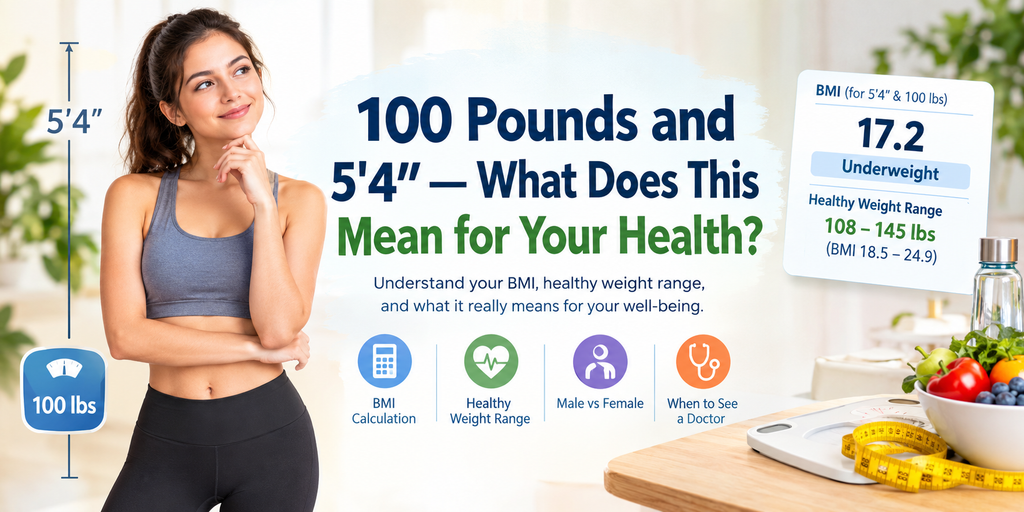
At 5'4" (163 cm), 100 pounds (45 kg) gives a BMI of about 17.2, which is considered underweight. A healthy weight range for 5'4" is about 108 to 145 pounds (49 to 66 kg).The situation is also different for children and teenagers. People under 20 are not assessed using the adult BMI categories in the same way. Their BMI is interpreted according to age and sex specific growth charts because the body is still developing.
So, if your search is 100 pounds 5 4, the short answer is that an adult at this height and weight has a BMI in the underweight category, but the number alone cannot tell you whether there is a health problem. The reason for the weight, whether it has changed recently, how you feel, and your overall growth or health history all matter.
Quick Answer: BMI Calculation for 5’4″ and 100 lbs
For an adult, the BMI calculation for 100 pounds at 5’4″ is approximately 17.16, usually rounded to 17.2. The calculation uses weight in pounds and height in inches. Since 5 feet 4 inches equals 64 inches, the formula is: BMI = (weight in pounds × 703) ÷ (height in inches)². Using 100 pounds and 64 inches gives a result of approximately 17.2. The CDC identifies an adult BMI below 18.5 as underweight, 18.5 to 24.9 as the healthy weight category, 25.0 to 29.9 as overweight, and 30 or higher as obesity.
That gives a clear answer to the search query 100 pounds 5 4 weight when the person is an adult: the calculated BMI is below the standard adult healthy BMI range. Still, BMI is best understood as a screening tool rather than a medical verdict. Someone’s height and scale weight cannot reveal muscle mass, bone structure, fat distribution, nutrition status, medical conditions, or recent changes in weight. The CDC specifically describes BMI as one potential health indicator rather than a replacement for a broader health assessment.
The most useful question is therefore not simply, “Is 100 pounds too little?” A better question is, “Is this weight appropriate for this person’s age, development, body composition, health history, and current symptoms?” That distinction is important because two people with the same height and weight can have very different health circumstances.
What Counts as a Healthy Weight at 5’4″?
For adults, the standard BMI range classified as healthy is 18.5 through 24.9. At a height of 5 feet 4 inches, those BMI boundaries correspond to approximately 108 to 145 pounds. That means 100 pounds is roughly 8 pounds below the lower boundary of the adult BMI category. These figures are mathematical conversions of the adult BMI categories and should not be interpreted as a personal target or “ideal” weight.
| Adult BMI category | BMI range | Approximate weight at 5’4″ |
|---|---|---|
| Underweight | Below 18.5 | Below about 108 lb |
| Healthy weight | 18.5–24.9 | About 108–145 lb |
| Overweight | 25.0–29.9 | About 146–174 lb |
| Obesity | 30.0 or higher | About 175 lb or more |
These ranges are useful for understanding the BMI calculation, but they should not become a scoreboard for judging someone’s body. BMI does not account for every factor that influences health, and the same BMI can have different meanings in different clinical situations. The CDC recommends discussing BMI with a healthcare professional when there are concerns rather than relying on the calculator alone.
This also explains why searches such as 100 pounds 5 4 female and 100 pounds 5 4 male can have the same basic adult BMI calculation. The mathematical BMI formula itself does not change based on whether the adult is male or female. What can differ is body composition, including the distribution of muscle and body fat, as well as other biological and health factors that BMI does not capture.
Does It Matter If You’re Male or Female?
For adults, the same BMI formula is used for men and women. Therefore, an adult male who is 5’4″ and 100 pounds and an adult female who is 5’4″ and 100 pounds would both have a calculated BMI of about 17.2. The BMI category would also be the same under the standard adult categories.
That does not mean their bodies or health circumstances are identical. Body composition varies substantially between individuals, and BMI cannot distinguish muscle from fat or account for differences in skeletal structure. A medical assessment may therefore consider additional information rather than treating the BMI number as the entire story.
Age is even more important when the person is still growing. A 100 pounds 5 4 female who is an adult is assessed differently from a teenager with the same measurements. For children and teens from ages 2 through 19, the CDC uses BMI for age and sex specific percentiles rather than applying adult BMI categories directly. This approach recognizes that growth and development change the meaning of height, weight, and BMI over time.
Why BMI Alone Doesn’t Tell the Whole Story
BMI is useful because it is simple, inexpensive, and easy to calculate, but simplicity is also its limitation. It combines height and weight into one number without directly measuring body fat, muscle, bone density, or where fat is distributed. The CDC describes BMI as a screening measure, which means it can help identify situations that deserve closer attention but does not independently diagnose a disease or determine someone’s complete health status.
What BMI Cannot Measure
Imagine two adults standing on the same scale and showing the same number. One could have a naturally small frame and a stable weight, while the other could have experienced significant unintentional weight loss over several months. Their BMI could be identical, but the health questions surrounding that number would be very different.
BMI also cannot tell you whether someone is getting enough nutrients, whether they have adequate muscle mass, or whether an underlying condition is affecting their weight. This is why a healthcare professional may look at medical history, symptoms, physical findings, nutrition, activity, and other measurements when evaluating a person whose BMI is low. The CDC specifically notes that BMI should be considered together with other factors when assessing health.
Looking Beyond the BMI Number
A broader health picture can include whether weight has remained relatively stable, whether there has been unexplained weight loss, how the person feels physically, and whether normal daily activities can be performed comfortably. Depending on the circumstances, a healthcare professional may also consider nutrition status, waist circumference, body composition, laboratory findings, and other clinical information.
This broader approach matters for the search term 100 pounds 5 4 weight loss as well. If someone has always been around this weight, the situation may be very different from someone who recently lost a substantial amount of weight without intending to. Unintentional weight loss can have many possible causes, including digestive problems, hormone conditions, chronic illness, medication effects, stress, and nutritional problems, so persistent unexplained changes deserve professional evaluation.
Is Being Underweight at 5’4″ and 100 lbs a Health Concern?
Being in the adult underweight BMI category does not automatically mean that someone has a medical problem. Some people naturally have smaller body frames and remain at a relatively low weight over long periods without experiencing health problems. Stability is one piece of the picture, although it does not replace an appropriate medical assessment when symptoms or concerns exist.
On the other hand, a low body weight can sometimes occur alongside inadequate nutrition or an underlying medical condition. The NHS notes that a BMI below 18.5 can be associated with risk of malnutrition, while signs such as persistent tiredness, weakness, frequent illness, and unintended weight loss can indicate that nutritional or medical assessment may be appropriate.
The key issue is context. If a person has unintentionally lost weight, feels persistently weak or tired, has changes in appetite, or has other concerning symptoms, the number on the scale becomes more important to investigate. The goal should not be to chase a particular appearance or number but to understand what is happening and support overall health.
Signs That Deserve Attention
A change in weight deserves more attention when it is unexplained, continuing, or accompanied by other symptoms. MedlinePlus defines unexplained weight loss as weight loss that occurs without intentionally trying to lose weight and advises contacting a healthcare professional when substantial unexplained loss occurs or when other symptoms are present.
Potential warning signs can include persistent fatigue, weakness, frequent illness, reduced appetite, digestive symptoms, dizziness, or other noticeable changes in health. For people who menstruate, significant changes in menstrual patterns can also be something to discuss with a healthcare professional rather than simply treating the change as a normal consequence of being thin.
None of these signs proves that a specific condition is present. They simply provide a reason to look beyond the BMI calculation. A clinician can consider the person’s complete history and decide whether further assessment is appropriate.
When to Talk to a Doctor
Talking with a healthcare professional is especially sensible when a person has experienced unintentional weight loss, has difficulty maintaining their usual weight, or has ongoing symptoms. MedlinePlus advises medical evaluation when someone loses more than 10 pounds or 5% of their normal body weight over 6 to 12 months without knowing why, although the appropriate response depends on the individual’s age, health, and circumstances.
A doctor or qualified healthcare professional can ask questions that a BMI calculator cannot answer. They may want to know when the change began, whether appetite has changed, whether digestion has been affected, whether there has been increased physical activity, whether illness occurred recently, and whether there are other symptoms. Depending on the situation, they may recommend an examination, laboratory testing, nutritional assessment, or referral to another professional.
It is also important to approach concerns about eating or body image without judgment. If eating has become stressful, frightening, or closely tied to concerns about body size, speaking with a trusted adult and an appropriate healthcare professional can provide support. For teenagers in particular, growth and development make individualized professional guidance more important than following adult weight rules found online.
How to Support a Healthy Weight Safely
If a healthcare professional determines that someone needs nutritional or weight support, the emphasis should be on health, nourishment, and sustainable habits, not rapid changes in body size. There is no single eating pattern that is appropriate for everyone, and individual needs can vary because of age, growth, medical conditions, activity level, medications, and other factors.
A registered dietitian or healthcare professional can help identify whether the issue is inadequate nutrition, an underlying condition, appetite changes, digestive problems, or something else. This is particularly important when weight has changed unexpectedly. Trying to solve unexplained weight changes without identifying the cause can delay appropriate care.
Focus on Nourishment
A healthy approach emphasizes a varied diet that provides the nutrients the body needs. Depending on an individual’s circumstances, this can include a mixture of protein sources, whole grains or other carbohydrate sources, fruits and vegetables, healthy fats, and sufficient fluids. The emphasis should be on nourishing the body rather than obsessively tracking numbers or trying to achieve a particular appearance.
For someone with a low BMI who has symptoms or unexplained weight changes, professional guidance is especially valuable. The NHS notes that being underweight can sometimes mean a person is not receiving enough vitamins and minerals and recommends medical advice when weight is lost suddenly or without changes in diet or exercise.
Build Strength and Support Function
Physical activity can also be part of a healthy lifestyle, but the purpose should be strength, mobility, energy, and everyday function rather than using exercise to manipulate body size. Strength based activity can support muscle and physical function when it is appropriate for the individual, but an exercise routine should take age, experience, health status, and nutritional needs into account.
Searches such as most push-ups with 100 pounds on back are not useful measures of whether a person at 5’4″ and 100 pounds is healthy. Performance numbers, social media challenges, and comparisons with other people cannot establish an individual’s nutritional status or medical wellbeing. A better measure is whether the person can participate in everyday activities comfortably and whether their overall health is being supported appropriately.
Conclusion
For an adult, 100 pounds at 5’4″ produces a BMI of approximately 17.2, which falls in the underweight category under standard adult BMI classifications. The mathematical answer is clear, but the health answer requires more context. BMI is a screening tool rather than a diagnosis, and it does not measure muscle, bone structure, fat distribution, nutrition status, or the reasons behind a person’s weight.
The distinction becomes especially important when comparing an adult with a teenager. A teenager should not simply apply adult BMI categories to their own body because BMI for people ages 2 through 19 is interpreted according to age and sex specific percentiles.
If 100 pounds at 5’4″ represents a stable pattern without concerning symptoms, the BMI number alone does not establish that something is wrong. If the weight has changed unexpectedly or there are symptoms such as persistent fatigue, weakness, appetite changes, digestive problems, or other health concerns, professional evaluation is a much more useful next step than relying on an online calculator. The goal is not to reach a particular number simply because a chart says so; it is to understand the individual’s health and support normal nutrition, development, strength, and wellbeing.
FAQs
For an adult, yes. At 5’4″ and 100 pounds, the calculated BMI is approximately 17.2, which is below the adult BMI threshold of 18.5 used by the CDC to define the underweight category. However, BMI is a screening measure and does not by itself diagnose a health problem.
For someone under 20, adult BMI categories should not be used in the same way. Children and teenagers are assessed using BMI for age and sex specific percentiles because their bodies are still growing.
There is not one universally appropriate or medically meaningful “ideal weight” for every person who is 5’4″. For adults, the standard BMI framework places approximately 108 to 145 pounds within the 18.5 to 24.9 BMI range at that height, but those figures are a screening reference rather than a personal target.
Health professionals can consider additional information such as medical history, body composition, symptoms, nutrition, and changes in weight when assessing an individual.
For adults, a BMI from 18.5 to 24.9 is classified by the CDC as the healthy weight category. At 5’4″, that corresponds mathematically to approximately 108 to 145 pounds. BMI should still be interpreted alongside other health information rather than used as the sole measure of wellbeing.
For children and teenagers, the interpretation is different because BMI is evaluated using age and sex specific percentiles.
Yes. This is one of the most important distinctions when searching 100 pounds 5 4. A 15-year-old should not use the adult BMI category of under 18.5 to decide whether their weight is healthy. The CDC uses BMI for age and sex specific percentiles for people ages 2 through 19 because growth and development affect how height and weight should be interpreted.
A healthcare professional can interpret a teenager’s growth pattern using the appropriate growth chart and the person’s broader health history.
BMI can sometimes give an incomplete picture because it does not distinguish among muscle, fat, bone, and other components of body weight. That is one reason the CDC recommends considering BMI together with other information rather than treating it as a standalone diagnosis.
For a person concerned about their BMI, a healthcare professional can consider body composition, health history, physical findings, nutrition, and other relevant factors to provide a more complete assessment.